Comparing NVIDIA and Super Micro: Which AI Stock to Choose?
The artificial intelligence (AI) revolution has sparked competition among hardware suppliers, with NVIDIA Corporation (NVDA) and Super Micro Computer, Inc. (SMCI) as key players. NVIDIA leads the AI graphics processing unit (GPU) market, while Super Micro designs efficient servers optimized for NVIDIA chips, catering to hyperscalers and enterprises. Both stocks have provided strong returns, but which one is the smarter investment today? This analysis explores their fundamentals, valuations, growth prospects, and potential risks.
NVIDIA: A Preeminent Force in AI Hardware
NVIDIA stands as a leader in AI chips, data centers, gaming, and autonomous vehicles, playing a critical role in the AI revolution. The data center segment has been a major revenue source, with Q4 fiscal 2025 revenues climbing 93% year over year to $35.58 billion.
In its latest earnings call, CEO Jensen Huang emphasized the soaring demand for advanced AI models that need significant computational power. The company’s Blackwell architecture promises up to 25 times the token throughput of its predecessor, setting the stage for the next phase of AI implementation.
NVIDIA plans to introduce its Blackwell Ultra and Vera Rubin platforms, which are likely to reinforce its status as a leading AI infrastructure provider. Given increasing investments in AI from governments and corporations, NVIDIA is positioned to benefit significantly from this transformational shift in technology.
However, recent export restrictions on H20 chips to China could impede NVIDIA’s financial growth in the short term. Jensen Huang revealed that these restrictions have cost the company $15 billion in sales, and it anticipates $5.5 billion in charges linked to the ban in Q1 of fiscal 2026.
Despite these challenges, NVIDIA is expected to thrive, forecasting revenues of $43 billion (+/- 2%) in Q1 of fiscal 2026, marking a year-over-year growth of more than 65%.
Super Micro: A High-Risk, High-Reward Investment
Super Micro Computer’s growth is fueled by the rising demand for AI workloads as data centers expand. Its high-performance, energy-efficient servers are increasingly popular among cloud service providers, government clients, and businesses capable of handling AI at scale.
Super Micro has enhanced its offerings by integrating NVIDIA’s Blackwell GPUs, which augment its computing power. Nevertheless, the company faces challenges such as delayed purchasing decisions as clients evaluate new AI platforms. Additionally, Super Micro is experiencing margin pressure amid rising competition and ongoing adjustments in pricing strategies.
In its latest results for Q3 fiscal 2025, Super Micro reported a one-time inventory write-down on older-generation GPUs and related components, further impacting its margins. As a result, the company has lowered its fiscal 2025 revenue guidance from $23.5-$25.0 billion to $21.8-$22.6 billion.
EPS Estimate Trends: A Comparative Analysis
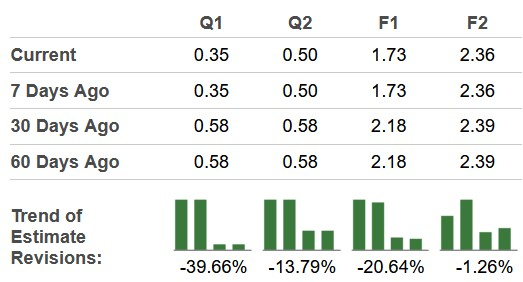
The Zacks Consensus Estimate indicates that Super Micro’s fiscal 2025 EPS will drop by 6%, while fiscal 2026 shows a potential growth of 36%. Over the past 60 days, the earnings estimate revision trends for both companies have displayed considerable volatility.
EPS Estimate Revision for SMCI
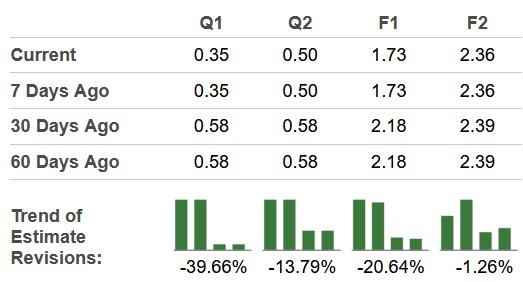
Image Source: Zacks Investment Research
For NVIDIA, the consensus estimates for fiscal 2026 and fiscal 2027 predict year-over-year EPS growth of 43% and 27%, respectively. The earnings estimate revisions for NVIDIA have remained notably stable, contrasting with Super Micro’s fluctuations, highlighting NVIDIA’s predictability in a volatile market.
EPS Estimate Revision for NVDA

Image Source: Zacks Investment Research
NVIDIA vs. Super Micro: Price Movement and Valuation
Both stocks have experienced share price volatility over the last year, influenced by geopolitical issues and economic uncertainty. NVIDIA shares have climbed 42.8%, while SMCI has dropped 50.6%.
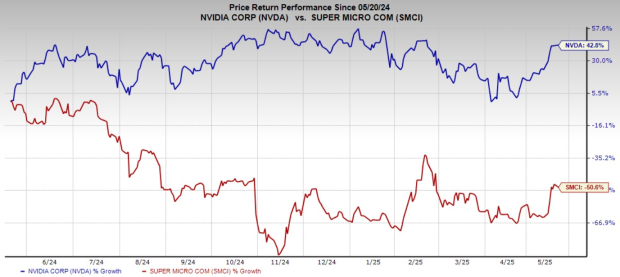
Image Source: Zacks Investment Research
In terms of valuation, both NVIDIA and Super Micro trade at earnings multiples below their industry averages. However, NVDA’s current price-to-earnings (P/E) multiple of 29.25X is significantly lower than its one-year median of 37.28X. In contrast, SMCI’s P/E ratio of 16.41X is slightly above its one-year median of 16.10X.
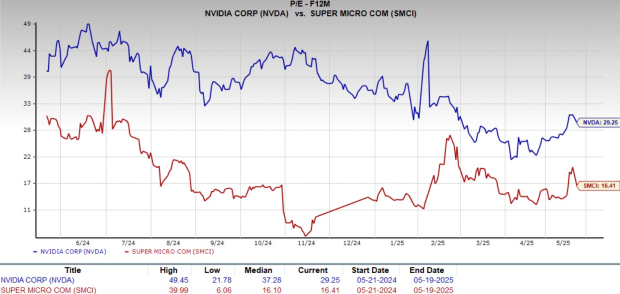
Image Source: Zacks Investment Research
While Super Micro appears cheaper on a P/E basis, it is accompanied by greater volatility and execution risks.
Conclusion: NVIDIA Leads as the Superior AI Hardware Investment
Amid the AI revolution, NVIDIA stands out as the more compelling investment compared to Super Micro. Its solid market position, innovative products, and earnings consistency make it a preferred choice for investors.
NVIDIA’s ability to navigate geopolitical challenges while forecasting significant growth for fiscal 2026—bolstered by its next-generation Blackwell architecture—reaffirms its competitive edge.
Conversely, Super Micro, though an intriguing high-risk, high-reward option, faces uncertainties related to product cycles, customer decisions, and margin pressures that cloud its outlook.
Presently, NVDA holds a Zacks Rank #3 (Hold), indicating stronger prospects compared to SMCI, which has a Zacks Rank #4 (Sell).
This article is for informational purposes only and does not constitute investment advice.
The views and opinions expressed herein are those of the author and do not necessarily reflect those of Nasdaq, Inc.