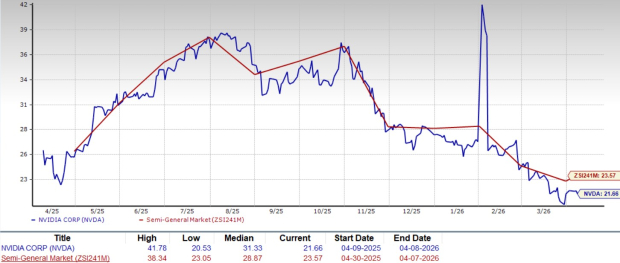
At last, the moment has arrived. In a meteoric rise that commenced last year, specialist in semiconductors Nvidia (NASDAQ: NVDA) surged ahead of Amazon (NASDAQ: AMZN) on Tuesday, boasting a market cap of $1.78 trillion, outpacing Amazon’s $1.75 trillion.
This isn’t the first time Nvidia has outstripped Amazon in worth. Nvidia blazed a trail with graphics processing units (GPUs) that transformed the gaming industry. It initially surpassed Amazon’s market cap in early 2001 and the two juggernauts traded places on the leaderboard several times over the ensuing year. However, by early 2002, Amazon had chalked up its maiden profit and initiated complimentary shipping for orders exceeding $99. These moves propelled the stock upwards, firmly establishing Amazon’s hegemony, a position it has held ever since.
The tech terrain is radically transformed today, offering fresh opportunities to both companies. Let’s delve into the path ahead and explore why one stock might emerge as the unequivocal victor going forward.

Image source: Getty Images.
The Rise of Nvidia
The last year has been transformative for Nvidia. Generative artificial intelligence (AI) stormed onto the scene in 2023, armed with the capability to generate fresh content, condense information, scour the internet and corporate databases for specific data, and even compose and debug computer code.
Accomplishing these feats necessitates substantial computing power, in which Nvidia unquestionably excels. It’s estimated that Nvidia commands around 95% of the market for chips used in machine learning, an antecedent branch of AI, according to CB Insights. As the foremost choice for existing AI processing, Nvidia held a definitive edge in the realm of generative AI applications.
The company enjoys another conspicuous advantage. Observations indicate that Nvidia chips account for approximately 95% of the GPUs employed in data centers to expedite information through cyberspace, as per CFRA analyst Angelo Zino. Consequently, as data centers hasten to amplify their operational capabilities, Nvidia stands as the primary port of call. Additionally, with an installed base approximated at $1 trillion, a multitude of data center upgrades are imperative to accommodate the burgeoning adoption of AI, positioning Nvidia to capture the lion’s share of this expenditure.
The Amazon Contingent
However, this is not to downplay Amazon’s standing. The company remains the unchallenged frontrunner in e-commerce. While the figures for 2023 are yet to be finalized, Amazon commandeered approximately 38% of the market in 2022, a figure prognosticated to surge to as much as 50% in 2024, according to online data provider Statista. Furthermore, Amazon Web Services (AWS) continues to reign supreme as the premier purveyor of cloud infrastructure services, seizing 31% of the market in the third quarter of 2023, reports research firm Canalys. In addition, the company is also ascending in the domain of digital advertising, commanding an estimated 10% of the market in 2023, according to Statista.
Amazon’s preeminence as the foremost cloud provider presents peradventure the most compelling ongoing opportunity, as cloud adoption is propelled by digital transformation, constituting the ideal conduit to dispense AI services to clients. The generative AI market is anticipated to exceed $1.3 trillion by 2032, as per Bloomberg Intelligence, and Amazon is well poised to carve out its share of this burgeoning landscape.
The Clear Victor
As a shareholder in Amazon, I harbor no intentions of divesting the stock, particularly considering its optionality and the myriad avenues for expansion. Nonetheless, if beckoned to choose between the two, I believe Nvidia currently personifies the unequivocal victor.
There’s also the matter of valuation to contemplate, but it’s not as straightforward as it may seem. Detractors will highlight that Nvidia trades for 40 times sales, in contrast to Amazon’s price-to-sales ratio of a mere 3, which ostensibly suggests Amazon is the more economical choice.
While this holds true, ponder this: In the past two quarters, Nvidia has burgeoned its revenue and profits by triple digits year over year, and is anticipated to do so once more when it unveils its fiscal 2024 fourth-quarter results next week. When factoring in its astronomical growth rate by utilizing the more pertinent price/earnings-to-growth (PEG) ratio, Nvidia’s valuation is 0.4 — with the benchmark for an undervalued stock set at less than 1. By way of comparison, Amazon is perched at precisely 1, implying that while it might be a bargain, it is certainly not a more economical choice than Nvidia.
The dawn of AI is but just commencing. Nvidia’s chips are the gold standard for AI applications, which is why there could be a bonanza in store for the GPU behemoth.
Should you invest $1,000 in Nvidia right now?
Prior to purchasing Nvidia stock, mull over this consideration:
The Motley Fool Stock Advisor analyst team recently pinpointed what they reckon are the 10 best stocks for investors to procure at present… and Nvidia didn’t make the cut. The 10 stocks that made the grade could yield colossal returns in the impending years.
Stock Advisor furnishes investors with a simple roadmap for success, encompassing guidance on constructing a portfolio, regular updates from analysts, and two new stock selections each month. The Stock Advisor service has outstripped the return of the S&P 500 thrice over since 2002*.
View the 10 stocks
*Stock Advisor returns as of February 12, 2024
John Mackey, former CEO of Whole Foods Market, an Amazon subsidiary, is a member of The Motley Fool’s board of directors. Danny Vena has positions in Amazon and Nvidia. The Motley Fool holds positions in and recommends Amazon and Nvidia. The Motley Fool has a disclosure policy.
The perspectives and opinions articulated herein are the personal views and opinions of the writer and do not necessarily mirror those of Nasdaq, Inc.