As the stock market experiences robust growth, some consumer food brands are struggling to keep pace, including industry stalwart PepsiCo (NASDAQ: PEP). While the S&P 500 has flourished with a 24% total return over the past year, PepsiCo stock has seen a slight decline. This dip comes as investors express apprehension over diminishing volumes and the potential impact of weight-loss medications on consumer demand.
Despite these challenges, PepsiCo has once again increased its dividend, marking an impressive streak of 52 consecutive years of dividend growth. This move has propelled its forward dividend yield above the 3% mark for the first time since the market lows of March 2020. The pivotal question arises: is now the opportune moment for long-term investors to consider adding PepsiCo shares to their portfolio?
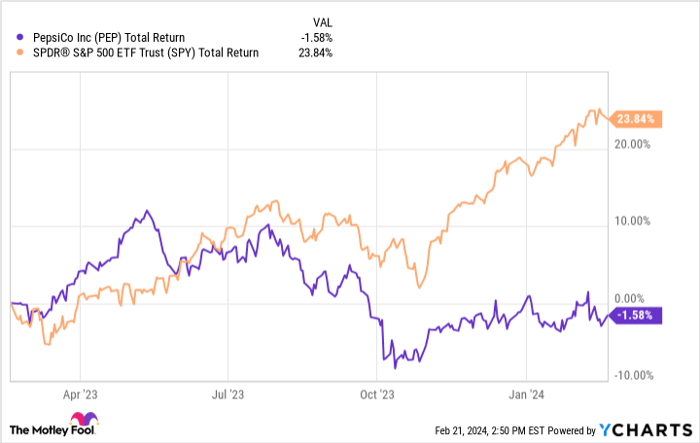
PEP Total Return Level data by YCharts
Analyzing Growth Despite Volume Declines
PepsiCo’s portfolio extends beyond its eponymous soda brand, encompassing various beverages like Gatorade and the dominant snack giant Frito-Lay, responsible for products such as Lays and Tostitos. In its recent fourth-quarter earnings report, the company showcased robust revenue growth, with total organic revenue climbing by 9% year over year to $91.4 billion.
Although PepsiCo boasts a global presence, its vital segments are North American drinks and food and snacks. These two entities collectively generated $52 billion in revenue and $9 billion in operating earnings last fiscal year. Despite ongoing growth in revenue fueled by price hikes, concerns loom over volume declines in North America, where Pepsi and Frito-Lay experienced decreases of 5% and 1%, respectively, compared to the prior year. While revenue continues to climb, there are apprehensions that the company may be reaching a saturation point as consumers resist further price increases on beloved soda and snack brands.
Every company has its pricing limits, and PepsiCo may be testing the bounds of its brand power. Alternatively, there could be another underlying cause contributing to these trends.
The Impact of Weight-Loss Drugs on Consumer Behavior
The emergence of new weight-loss medications such as Ozempic has gained significant traction in affluent countries in recent years, with a projected 7% or higher portion of the U.S. populace expected to be using these drugs by 2035. Given that 40% of Americans are classified as obese, there is a notion that companies like PepsiCo shoulder some responsibility for this issue.
These drugs operate by curbing cravings and appetites, leading individuals to consume fewer calories, particularly reducing the consumption of junk food. This shift could pose a substantial challenge to products like Pepsi soda and Lay’s chips. The company’s operational metrics may already be reflecting these headwinds, with volumes in North America exhibiting a sudden downturn last year.
While a 7% adoption rate of Ozempic might not seem significant for PepsiCo initially, it’s crucial to note that consumption of soda, snack foods, and candies tends to be skewed towards individuals struggling with obesity and diabetes – precisely the demographic likely to utilize Ozempic. Continued growth in the usage of such drugs could deliver a significant blow to PepsiCo’s demand in the coming years.
Evaluating PepsiCo’s Valuation and Industry Challenges
Even in a scenario where PepsiCo mirrors a tobacco company’s trajectory – featuring volume declines alongside price hikes – it does not spell the demise of the company. Tobacco stocks have historically been some of the top performers, as investors consistently underestimated their capacity to raise prices ahead of inflation.
Analogous trends could unfold for PepsiCo, particularly if its snack offerings transition from daily staples to occasional indulgences. With a dividend yield exceeding 3%, the current juncture appears attractive for investors eyeing a dividend growth opportunity at a reasonable valuation.
Nonetheless, investors must closely monitor PepsiCo’s volume trends. While the threat posed by weight-loss drugs may be overstated, these declines could serve as an early warning sign for the future trajectory of the soda and snack food industry. While Pepsi stock appears undervalued, prudent investors should approach the company with vigilance, not blind optimism.
Considering an Investment in PepsiCo?
Before diving into PepsiCo stock, it’s essential to heed this insight:
The Motley Fool Stock Advisor team has recently pinpointed what they believe are the 10 most promising stocks for investors to consider. Surprisingly, PepsiCo did not make the cut among this elite group. The selected stocks have the potential to yield substantial returns in the coming years.
Stock Advisor furnishes investors with a clear roadmap to success, offering guidance on portfolio construction, frequent analyst updates, and two fresh stock recommendations monthly. Since 2002, the Stock Advisor service has outperformed the S&P 500 triple times over*.
Explore the 10 highlighted stocks
*Stock Advisor returns as of February 20, 2024
Brett Schafer holds no positions in the mentioned stocks. The Motley Fool and its affiliates do not have any positions in the mentioned stocks. The Motley Fool abides by a strict disclosure policy.
The opinions articulated in this content solely belong to the author and do not necessarily mirror those of Nasdaq, Inc.