Pfizer (PFE) investors are grappling with a rough ride as the stock took a staggering 44% hit last year – firmly planting itself as one of the worst-performing S&P 500 Index ($SPX) stocks. The dip was particularly painful as it occurred despite record market highs. Initial peaks in December 2021 saw the company’s market cap soaring past $300 billion, only for it to dwindle to nearly half of that in the present. The situation offers little respite, as sector peer Moderna (MRNA) – a fellow developer of a COVID-19 vaccine – similarly sunk in 2023, mirroring Pfizer’s downturn.
The looming question is: Will Pfizer’s stock stage a resurrection over the next few years, or will it continue to stagnate? Here’s a 2025 forecast for PFE and the pivotal influencers that could potentially trigger a turnaround.
Why Has Pfizer Stock Fallen?
The crux of Pfizer’s recent tumble can be attributed to the dwindling sales of its COVID-19 products. This includes the COVID-19 vaccine, Comirnaty, and the Paxlovid pill utilized in treating active infections.

Delving into Pfizer’s earnings reveals a telling narrative behind the stock’s slump. In 2023, Pfizer reported a substantial revenue drop of 42%, totaling $58.5 billion, compared to the previous year. Although the company’s non-COVID sales saw an 8% uptick, it failed to offset the adverse impact of sagging Paxlovid and Comirnaty sales.
Looking ahead, Pfizer’s management anticipates Paxlovid and Comirnaty sales of $3 billion and $5 billion, respectively, in 2024. Even combined, this projected $8 billion in sales pales in comparison to the equivalent $57 billion in sales in 2022.
However, Pfizer’s challenges extend beyond its COVID-19 portfolio. In December, the company halted the development of its weight loss drug, danuglipron, due to adverse side effects. Additionally, some believe that Pfizer overspent in its Seagen acquisition, leading to an additional $31 billion in debt burdening its balance sheet.
Pfizer Stock 2025 Forecast: Seagen, New Products Could Be Key
The prospect of Pfizer’s COVID-19 portfolio revival seems bleak unless there’s an undesirable resurgence in infections. As a result, Pfizer’s 2025 forecast is likely contingent on new product ventures and sales proceeds from Seagen.
Pfizer anticipates Seagen revenues to reach $3.1 billion in 2024, with a gradual increase to at least $10 billion by 2030. During the Q4 earnings call, Pfizer’s CEO, Albert Bourla, mentioned that the company is “exploring further opportunities to advance a number of innovative combination regimens.” He further stated, “We believe we are well-positioned to bring our global commercial manufacturing and supply capabilities to accelerate current and future marketed products. We believe all these components support our growth potential through 2024 and drive growth potential into 2025.”
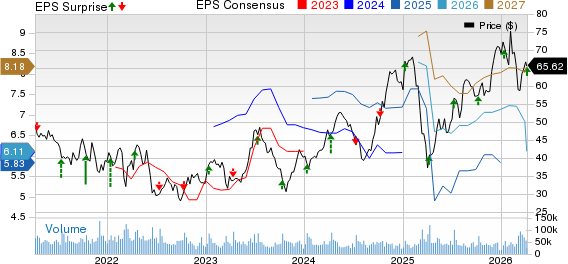
For 2024, Pfizer forecasts revenues ranging between $58.5 billion to $61.5 billion. According to analysts, the company’s growth is expected to pick up, with consensus estimates calling for a 5.8% year-on-year revenue upswing in 2025.
Pfizer aims to achieve incremental net cost savings of $2 billion by the end of 2024. Coupled with the $2 billion realized in 2023, this would bring the cumulative savings to $4 billion. The company is also focused on reducing its leverage ratios and expects operating margins to gradually ascend into the “mid- to high 30s.”
Analysts Expect Pfizer Stock to Go Higher
PFE has garnered a consensus rating of “Moderate Buy” from analysts, with a mean target price of $36.11 – a 33% surge from Wednesday’s closing price. Among the 18 analysts covering the stock, 7 rate it as a “Strong Buy,” 1 as a “Moderate Buy,” and the remaining 10 as a “Hold.”
Even the most pessimistic analysts don’t foresee a further decline, with the Street-low target price of $27 roughly aligning with current prices. However, the Street-high target price of $54 signals a potential doubling of the stock from its current levels.

Despite Pfizer stock surrendering its COVID-era gains and regressing to 2016 levels, its risk-reward profile appears favorable at the current juncture. While a re-rating might take time, hinging predominantly on the shape of its product pipeline post the obesity drug debacle, this scenario offers a fascinating prospect.
Overall, amid the COVID-19 product sales steadying (albeit at a considerably reduced base), robust revenue growth in the non-COVID portfolio, attention to cost reduction, and debt reduction endeavors, Pfizer stock warrants attention. Furthermore, its next 12-month price-to-earnings multiple of 12.2x stands well below long-term averages, coupled with a dividend yield surpassing 6%, placing Pfizer stock favorably for most value investors.
On the date of publication, Mohit Oberoi held a position in: PFE. All information and data in this article is solely for informational purposes. For more information please view the Barchart Disclosure Policy here.
The views and opinions expressed herein are the views and opinions of the author and do not necessarily reflect those of Nasdaq, Inc.