Tesla’s Future Growth: Insights from Cathie Wood’s Predictions
Tesla (NASDAQ: TSLA) has faced a challenging start to 2025, with shares declining by 25% in the first four months. However, Cathie Wood of the ARK Innovation ETF (NYSEMKT: ARKK) believes that over the long term, Tesla’s share price could increase from $300 to more than $2,600. In a recent interview, Wood projected that Tesla’s stock might rise by over 1,000% in the next five years, attributing this dramatic growth potential mainly to one key catalyst.
Key Catalysts for Tesla’s Growth
Historically, new product launches have significantly driven Tesla’s sales growth. Sales surged when the company introduced high-end models like the Model S and Model X. However, mass-market vehicles such as the Model Y and Model 3 have been pivotal in establishing Tesla’s current success. Last year, Tesla delivered around 1.8 million vehicles, with over 1.7 million being Model 3 or Model Y.
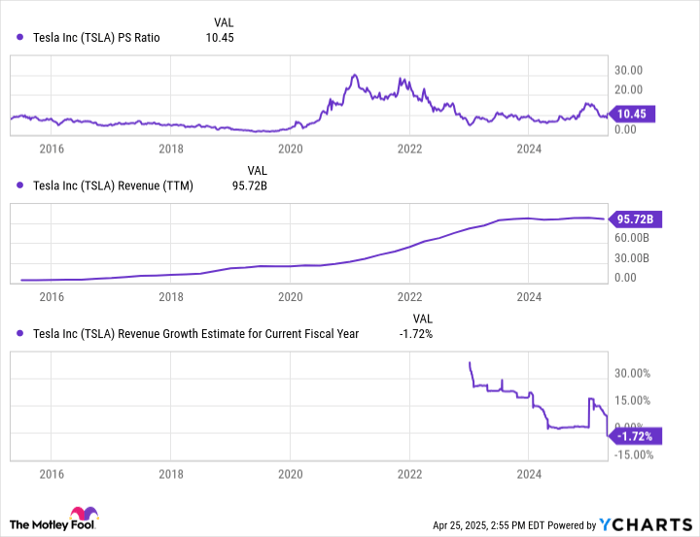
This year, analysts expect negative sales growth due to limited new products. The Model 3 entered deliveries in 2017, and the Model Y launched in 2020, making these models eight and five years old, respectively. Despite updates, Tesla’s product lineup feels dated compared to competitors like Lucid Group and Rivian, which are launching new mass-market models in 2026 and 2027.
Despite subdued growth projections, Wood is optimistic that a major new product in 2026 will revolutionize Tesla’s future. Interestingly, this innovation is not merely a new vehicle; it centers on a new service—Tesla’s much-anticipated robotaxi network.

TSLA PS Ratio data by YCharts
The Robotic Taxi Vision
There has been long-standing anticipation for Tesla to introduce a $25,000 model, a more affordable option compared to the Model 3 and Model Y. Elon Musk has fueled these expectations over the years. However, last November, he announced that this model would not require a human driver; it would operate entirely autonomously and is referred to as Tesla’s Cybertaxi. Musk stated that production of the Cybercab will commence in 2026 after fully autonomous versions of the Model 3 and Model Y are launched in Texas and California next year.
Musk’s predictions are often viewed with skepticism. Still, if Tesla begins producing the Cybercab next year and activates fully autonomous driving for its existing models, the company will likely play a significant role in the autonomous car-sharing sector.
To date, Tesla has sold over 7 million vehicles, with about 5 million still on the road. In contrast, Uber Technologies, with a $160 billion market cap, has around 8 million active drivers. Tesla’s model could potentially yield better margins than Uber’s, as it would not need to split revenues with drivers, though it will still share income with car owners. This raises concerns about Wood’s projections compared to Uber’s current valuation. Uber’s ride-sharing service is valued at $160 billion, while Wood anticipates trillions would be added to Tesla’s market cap.
While autonomous driving may expand the ride-sharing market significantly, current figures do not support Wood’s optimistic outlook. Historically, her forecasts have often been ambitious. Although Tesla remains a compelling long-term investment, the prediction of a $2,600 per-share price in five years appears overly optimistic based on existing data.
The views and opinions expressed herein are those of the author and do not necessarily reflect those of Nasdaq, Inc.