It’s undeniable that the business landscape has been shaped by some of the fastest-growing, most profitable, and most powerful businesses in modern history. Over the past year, a group of companies, known as the “Magnificent Seven,” has come to the forefront. The ascent of these formidable entities is attributed to the relentless progression of information technology, computing power, and the internet, all built upon the practical application of semiconductors. Recently, there has been a significant shake-up in the ranking of the Magnificent Seven stocks, prompting a need for investors to stay informed about the latest developments.
Nvidia Surpasses Competition
In a groundbreaking turn of events in mid-February 2024, Nvidia, often perceived as the smallest of the Magnificent Seven based on revenue and total employees, exceeded the total market capitalization value of Google-parent Alphabet and Amazon. This paradigm shift represents a transformative era, as investors flock to what is increasingly recognized as the leading force in the new artificial intelligence (AI) economy.
| Company | Year Founded | Market Cap | Trailing-12-Month Revenue | Total Employees |
|---|---|---|---|---|
| Microsoft | 1975 | $3.02 trillion | $228 billion | 221,000 |
| Apple | 1976 | $2.84 trillion | $386 billion | 161,000 |
| Nvidia | 1993 | $1.80 trillion | $44.9 billion | 26,000 |
| Alphabet | 1998 | $1.78 trillion | $307 billion | 183,000 |
| Amazon | 1994 | $1.76 trillion | $575 billion | 1.5 million |
| Meta Platforms | 2004 | $1.23 trillion | $135 billion | 67,000 |
| Tesla | 2003 | $639 billion | $96.8 billion | 140,000 |
Data source: YCharts and company financial filings, as of Feb. 16, 2024.
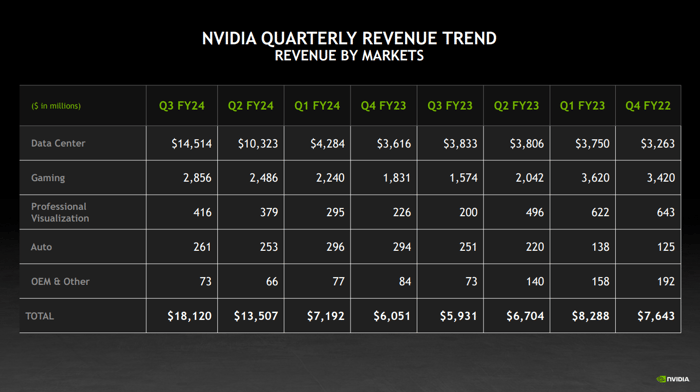
Boasting the third-largest market cap among the Magnificent Seven index, Nvidia’s achievement is particularly striking considering its relatively modest size. In fact, when compared to the other companies listed, Nvidia has the longest tenure in the industry. Succeeding primarily due to its AI infrastructure, Nvidia’s business model appears somewhat esoteric to the average consumer. While Nvidia has garnered recognition in the consumer space, particularly in the realm of PC video games, the majority of its revenue does not stem from this sector. The company’s crucial decision to focus on semiconductor and accelerated computing infrastructure development has propelled its data center segment to unprecedented heights in the past year.
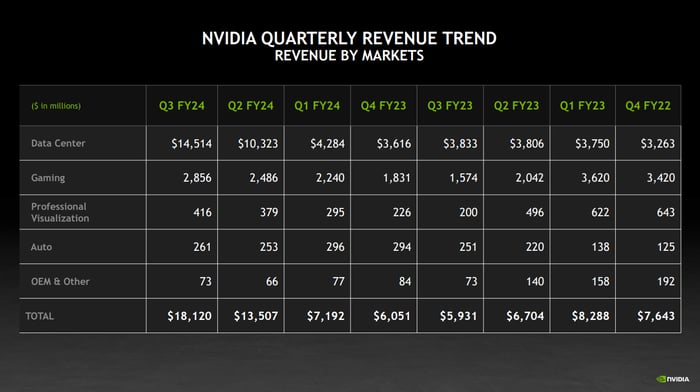
Image source: Nvidia.
Three Stats, and Their Significance for Investors
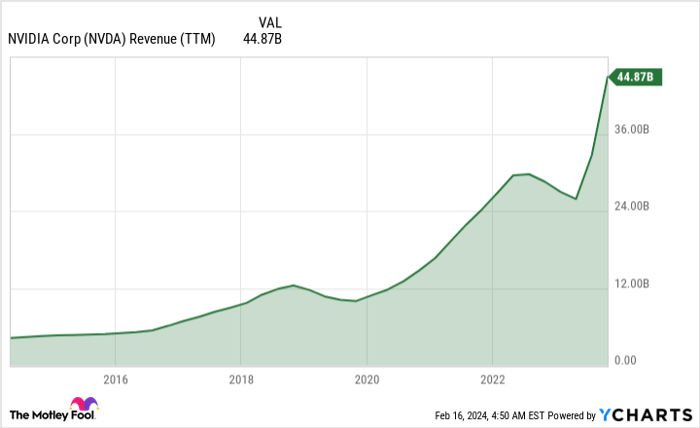
Undoubtedly, Nvidia’s rise to prominence as the third-largest company in the Magnificent Seven index, based on market capitalization, is truly remarkable. When coupled with the two additional metrics in the aforementioned chart—revenue and total employee count—it is evident that investors are wagering on significant expansion in Nvidia’s core business in the coming years. It’s important to underline the term “wagering.” While Nvidia has been laying the groundwork for next-generation computing infrastructure for years, it has only recently gained widespread recognition from the investor community. Assurances of Nvidia’s perpetual ascendancy should be tempered by the understanding that the company experiences highly cyclical revenue, much like most research and development-driven semiconductor firms.
Data by YCharts.
It is a reasonable assumption that at an unforeseen point in the future, there will be a downturn in AI infrastructure spending. When this occurs, expect Nvidia’s stock to undergo a significant sell-off, as it has in the past. As a longstanding shareholder of Nvidia, it is invigorating to witness the company’s rapid advancements. However, it is prudent to remain cautious amidst the escalating prominence of the company within the Magnificent Seven. While these businesses are undoubtedly top-tier investments, they all undergo cycles of growth and periods of subdued performance. An ample dose of circumspection will undoubtedly serve the long-term interests of investors at this juncture.
Should you invest $1,000 in Nvidia right now?
Before purchasing Nvidia stock, it is essential to consider the following: The analysts at Motley Fool Stock Advisor have identified what they believe are the 10 best stocks for investors to purchase presently, with Nvidia notably absent from the list. These selected stocks have the potential to yield substantial returns in the years ahead.
Stock Advisor equips investors with a straightforward plan for success, offering guidance on constructing a portfolio, regular analyst updates, and two new stock picks each month. Since 2002, the Stock Advisor service has outperformed the S&P 500 by more than threefold.
See the 10 stocks
*Stock Advisor returns as of February 12, 2024
Suzanne Frey, an executive at Alphabet, is a member of The Motley Fool’s board of directors. Randi Zuckerberg, a former director of market development and spokeswoman for Facebook and sister to Meta Platforms CEO Mark Zuckerberg, is a member of The Motley Fool’s board of directors. John Mackey, former CEO of Whole Foods Market, an Amazon subsidiary, is a member of The Motley Fool’s board of directors. Nick Rossolillo and his clients have positions in Alphabet, Amazon, Apple, Meta Platforms, Nvidia, and Tesla. The Motley Fool has positions in and recommends Alphabet, Amazon, Apple, Meta Platforms, Microsoft, Nvidia, and Tesla. The Motley Fool recommends the following options: long January 2026 $395 calls on Microsoft and short January 2026 $405 calls on Microsoft. The Motley Fool has a disclosure policy.
The views and opinions expressed herein are the views and opinions of the author and do not necessarily reflect those of Nasdaq, Inc.