Written by Sam Kovacs
An Honest Evaluation
Every active investor must confront a pivotal question – are they truly adding value, or could their time be better spent on the golf course, basking in the joys of an ETF like the SPDR S&P 500 ETF Trust (SPY)?
The comparison to the S&P 500, a beacon in the investment world, is an inevitable litmus test for any investor’s acumen.
Can one surpass or at least match it? Failing to do so implies a high cost of solitary investing, warranting a shift towards a passive approach or enhancing decision-making resources.
In this light, we will review our performance against the S&P 500, not to boast, but to illuminate the disparities between active and passive investment choices.
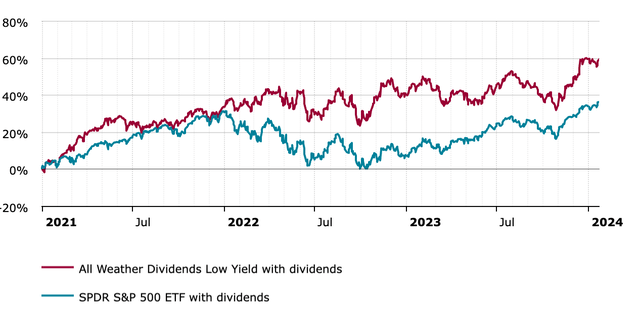
From the portfolio’s inception to the close of 2023, the Low Yield Portfolio yielded a striking 59.8% return compared to the S&P 500’s 33.6%.
Our Distinctive Investment Philosophy
The Low Yield Portfolio adheres to a meticulously devised methodology:
- Select “All Weather” dividend stocks: Stocks boasting solid dividend growth records backed by robust businesses.
- Seize them at their nadir: Valuation is the linchpin; positions are assumed when the market undervalues them substantially.
- Offload at their zenith: Recognizing that quality opportunities abound, we realize gains in overvalued positions.
- Consistently gain while waiting: Ensure ownership of companies delivering substantial and rapidly growing dividends.
Simply put, our strategy is elegantly uncomplicated.
A sterling embodiment of our philosophy is Home Depot (HD), graphically illustrated below.
Home Depot impeccably epitomizes our strategy.
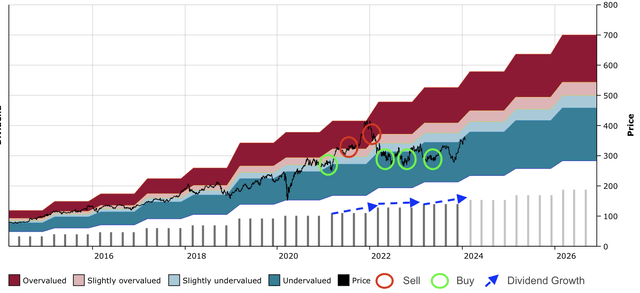
It has sustained double-digit dividend growth for decades, vacillating between undervalued and overvalued phases, which we have astutely exploited since the inception of the portfolio.
To illustrate, we entered at $260, exited at $380, re-entered at $290, and presently, HD stands at $350.
Factoring in the gains we secured, this translates to a mean $180 gain per traded share, or a 69% return on the HD trade, exclusive of dividends.
This sharpens the focus on the value of capitalizing on highs, a facet often disregarded by investors.
HD ranks as the 10th largest position in our portfolio, constituting 3% of the portfolio.
We impose a 5% cost cap on any position, enabling multiple positions to function synergistically with HD.
Now, let’s explore the perennially popular ETF.
Meet SCHD: The Beloved Dividend ETF
Over the same 3-year span, SCHD yielded a modest 31% return.
In contrast, our Low Yield Portfolio outperformed by double…
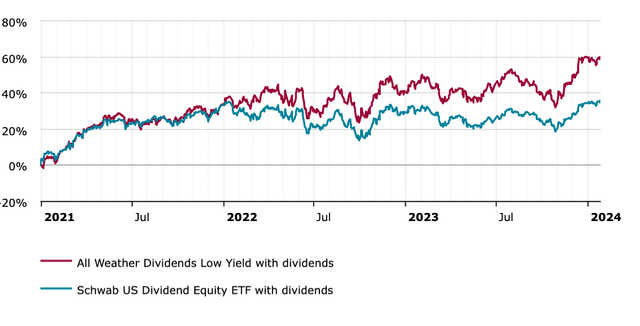
The discussion on SCHD’s relevance triumphs over that of the S&P 500.
SCHD, a dividend ETF mirroring the Dow Jones US Dividend 100, merits comprehension through an in-depth exploration of the index’s methodology.
Let’s delve deeper into the intricate framework of the index:
-
Purpose of the Index: This index comprises 100 companies distinguished for unwaveringly dispensing dividends to shareholders for a minimum of 10 years. Dividends represent a slice of a company’s profits disbursed to shareholders.
-
Criteria for Company Selection: Companies are selected based on the following benchmarks:
- Annual dividend payments spanning 10 years.
- Minimum Full Market Capitalization of $500 million, indicating the company’s scale and worth.
- Minimum Average Daily Trading Volume of $2 million over three months, reflecting stock liquidity.
-
Ranking Process: Companies meeting these criteria are ranked according to their Indicated Annual Dividend (IAD).
The Dividend Battle Royale: A Detailed View of SCHD and the Dow Jones U.S. Dividend 100 Index
When it comes to dividend-focused investing, the competition is feverish, with various strategies clashing to attract investors. One such battleground is between Charles Schwab’s SCHD and the Dow Jones U.S. Dividend 100 Index. A scrutiny of the methodologies reveals intriguingly similar stock preferences. Delve with me into the nitty-gritty of these financially titan-like indexes.
Selecting the Creme de la Creme
Unlike a whimsical lottery, the Dow Jones U.S. Dividend 100 Index prudently winnows out companies based on their dividend yield. This crucial metric, obtained by dividing the annual dividend by the stock’s price, becomes the litmus test. The select few are the top half of these companies. These chosen ones must weather through multiple financial metrics to secure a prized spot in the index, with the free cash flow to total debt ratio, return on equity, IAD yield, and five-year dividend growth rate standing as rigid measures of their worth.
The Quest for Perfection: Choosing the Top 100
The annual selection amalgamates the scores derived from these stringent criteria, as the financial prowess of a company comes under the magnifying glass. Only those who triumph and rendezvous in the top 100 echelon are bestowed the honor of being featured in the index, a validation of their resilience and monetary mettle.
The Ever-Changing Roster
Yet, even those favored with a spot in the top 100 cannot rest on their laurels. A yearly review scrutinizes the financial fortitude of existing companies, culling the weak and embracing the strong. The index adapts, ensuring a coalescence of the crème de la crème, a dynamic ecosystem for investors hunting stability and revenue.
Keeping the Scales Balanced
Every quarter, a balancing act commences, as the index is adjusted to avoid domination by any single company or industry sector. There exists a prophylactic cap, underscoring the merit of diversity. No single company can surge beyond 4% of the index, and no lone industry sector intercepts more than 25%.
All’s Fair in the Battle of Dividends: SCHD vs. Dow Jones U.S. Dividend 100 Index
Surveying the methodology of the Dow Jones U.S. Dividend 100 Index uncloaks remarkable similarities with our very own SCHD. The philosophy underpinning these indexes converges on anchoring investments in stocks with a robust dividend growth history, cash flow generation, and the pursuit of yield. The index has indeed been casting its net upon the same waters as ours, an entanglement of methodology that is both baffling and intriguing.
An Odyssey of Holdings
A glance at the fund’s holdings reveals an uncanny overlap with our portfolio. A myriad of familiar names grace the roster, with Broadcom (AVGO) standing as the flagbearer, commanding significant weightage in both the indexes. It’s almost as if our portfolios share a symbiotic relationship, navigating the tempestuous seas of stock holdings and triumphing together.
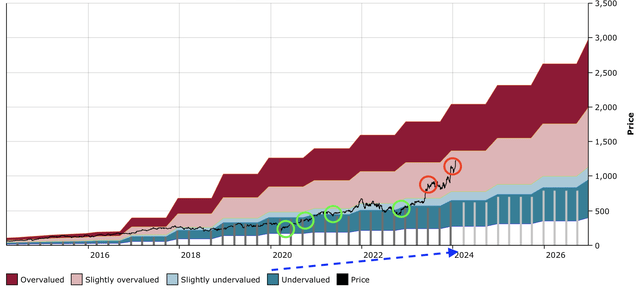
Our unyielding faith in certain positions, such as AVGO, has proved sagacious, reaping us commendable profits and cementing its standing as a cornerstone of both our portfolios. The convergence of our investment inclinations with that of the Dow Jones U.S. Dividend 100 Index is not just serendipitous but a testament to the wisdom of our investment philosophy.
Striking a Chord with Shared Holdings
The SCHD’s prestigious top 30 stocks resonate with our own choices. From BlackRock (BLK) to Amgen (AMGN), the overlap is striking, a harmonious symphony that reverberates across the realm of dividend investing. It’s a validation of our choices and an acknowledgment of the prudent path we tread, entwined with that of the illustrious Dow Jones U.S. Dividend 100 Index.
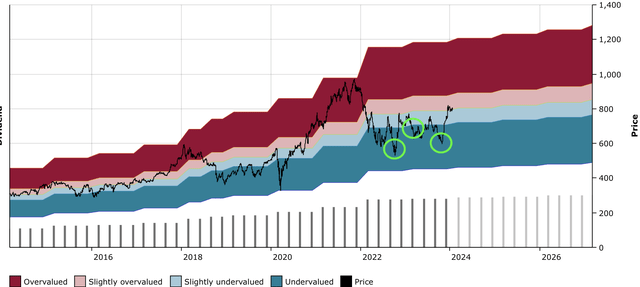
Our odyssey in accumulating shares of BlackRock (BLK) mirrors the journey of the index, a testament to our foresight and the adage that greatness recognizes greatness. The convergence of our noble venture with that of the index is not a mere coincidence but a symphony of astute investment strategies.
Amgen (AMGN), another vaunted position in our portfolio, finds itself in the upper echelons of the SCHD, corroborating our vision and fortifying the alliance between our choices and that of the index.
The Secret Sauce Behind Outperforming SCHD
Over the past 3 years, annualized SCHD has returned 9.5%, while the low yield portfolio has returned 16.8%. A 7.3% annual outperformance is pretty decent. So why, if our methodologies are so similar, have we nearly doubled SCHD’s returns? There are a few reasons which we’ll examine now.
The Advantage of Active Investing
The active investor has an edge that the SCHD passive investor doesn’t have.
1. Navigating Sector Rotation
- Active investors have the flexibility to engage in sector rotation, a strategy where they shift their investments from one sector of the economy to another based on market trends, economic forecasts, or changes in the business cycle.
- By doing this, active investors can target sectors that are poised for growth or undervalued, potentially leading to higher dividend yields and capital appreciation.
- In contrast, an ETF like SCHD follows a fixed index that may not adapt quickly to changing market conditions, limiting opportunities for tactical shifts in response to economic or sector-specific developments.
Since 2020, there have been a number of sector or industry rotations from which we’ve benefited. We’ve made profitable investments in the energy and semiconductor sectors while avoiding potential pitfalls in tech, utilities, and office REITs. Notably, our investments in REITs have given us a significant advantage over SCHD, which does not invest in this sector. As rates decrease, the sector is likely to see an upward trend, a cycle we’ve witnessed repeatedly.
2. Timing Investments for Maximum Impact
- Active investors can strategically time their stock purchases to capitalize on market dips, maximizing dividend yield as a percentage of the purchase price.
- They can also use market volatility to their advantage, buying stocks when they are undervalued and potentially selling them when they are overvalued.
- Passive ETFs, on the other hand, are generally rebalanced on a set schedule, which may not always align with optimal buying or selling times.
Being able to “buy low and sell high” is what gives active investors an edge. An example of this is our investment in 3M, which we bought at a low average price and subsequently sold at a high average price, capitalizing on the market fluctuations. SCHD investors would find it challenging to achieve similar results.
3. Selecting Superior Stocks
- Active investors have the autonomy to handpick individual stocks based on a wide range of criteria, including dividend history, company fundamentals, growth potential, and management quality.
- This tailored approach allows for a more personalized portfolio that aligns with specific investment goals, risk tolerance, and income needs.
- In contrast, SCHD and similar ETFs adhere to a predetermined set of rules for stock selection, which may include stocks that an active investor would otherwise avoid based on more nuanced or forward-looking assessments.
From the list of 30 stocks which comprise the 85% of SCHD’s assets, there are a few names that jump out to me as overvalued or not aligned with the goals of a discerning dividend investor. Stocks like Cisco (CSCO) illustrate this, having grown its dividend at a slow rate. SCHD’s filters have not necessarily weeded out such counterproductive stocks.
The Importance of Active Investing and Dividend Growth
In the world of investing, the allure of dividends has been akin to a siren’s call, drawing in investors and promising return on investment. However, the slow growth of dividends from stalwart companies like Cisco (CSCO) and Kimberly-Clark (KMB) has sparked a discussion about the efficacy of pursuing dividend growth in the current market.
The Predicament of Dividend Yields
Cisco, at its current price of $52, boasts a yield of 3%. Yet, some argue this yield isn’t sufficient to justify the gradual increase in dividends. Similarly, Kimberly-Clark, with a 4% yield, exceeds Cisco by 1%, but its dividend growth rate hovers at 3% annually, undermining its allure for investors.
Effective Stock Selection
These stocks have inadvertently diluted the performance of the SCHD, all while maintaining an appearance of safety and stability. However, they may lack the necessary vigor to fully support the dividend aspirations of investors seeking high returns.
Realizing Superior Returns
Obtaining superior returns requires a pragmatic and return-oriented mindset. While experienced investors may make mistakes, over the long term, their rational and level-headed approach to stock selection is likely to yield substantial rewards.
- approach the markets with a pragmatic, return oriented mindset;
- employ common sense when performing stock selection;
- acknowledge that mistakes may occur, but persistence is key.
Does the time spent generating superior returns pay off? The gains from years 1 through 3 demonstrate the performance differential between the S&P 500 and the Low Yield Portfolio, and the impact of every percentage point of outperformance over the years.
A chart from investor.gov highlights the compounding evolution of $100,000 at a rate of 16.8% (for the Low Yield Portfolio) compared to 10.8% for the S&P 500, demonstrating the significant advantage of active investing in generating returns.
The Ascendancy of Active Investing
Active investors still have an important role to play in an era dominated by passive ETF investment. Choosing stocks with strong potential for dividend growth, and thereby achieving superior returns, remains a vital strategy for those who seek to build a robust investment portfolio.