Impact of Tariffs on Eli Lilly: Navigating Short-Term Challenges
Recent tariffs introduced by President Donald Trump have revealed weaknesses across various industries, including the pharmaceutical sector. While the direct effects on pharmaceutical companies are not yet fully tangible, the looming uncertainty surrounding potential new tariffs has left executives and investors feeling uneasy.
Pharmaceutical Sector Faces Uncertainty Amid Tariff Talks
One notable example is Eli Lilly (NYSE: LLY). So far, the company’s operations haven’t been directly impacted by the tariffs. However, the potential for sudden changes in policy has made investors apprehensive about future performance. It’s essential to assess how impending tariff scenarios could affect Eli Lilly’s operations and whether current investment in the stock is wise.
Impacts of Tariffs on Eli Lilly’s Business
A major concern for pharmaceutical companies goes beyond research and development (R&D) costs; it significantly includes the expenses related to sourcing raw materials for drug production, often imported from abroad. Should tariffs be enforced on pharmaceuticals, it could lead to increased costs for these essential ingredients. Additionally, as global trade tensions escalate, retaliatory tariffs from other nations might negatively affect Eli Lilly’s brand reputation internationally.
If the company encounters these challenges, it may need to brace for rising operating expenses and potentially dwindling profit margins in the short-term.

Image source: Getty Images.
Long-Term Growth Prospects Remain Bright
While tariff policies can create complex dynamics with possible exemptions for certain markets, Eli Lilly’s immediate outlook appears less favorable. However, optimism about the company’s long-term future remains strong.
The growth of Eli Lilly has been significantly driven by blockbuster medications like Mounjaro and Zepbound. These glucagon-like peptide-1 (GLP-1) drugs effectively compete against Novo Nordisk‘s Ozempic and Wegovy. In recent years, the weight loss drug market has surged, providing substantial momentum for pharmaceutical companies, including Eli Lilly.
Moreover, Eli Lilly offers Verzenio, a rapidly growing cancer treatment. This drug, approved by the Food and Drug Administration (FDA), enhances the company’s standing in the oncology market.
There’s also promise in the Alzheimer’s disease (AD) sector, projected to be worth billions in coming years with little competition. Last summer, Lilly secured FDA approval for Kisunla, its AD medication, suggesting tangible growth opportunities beyond immediate tariffs.
Considerations for Investing in Eli Lilly Stock
If tariffs indeed affect the pharmaceutical industry, Eli Lilly may need to adjust its strategies temporarily. Rising raw material costs and supply chain disruptions could force the company to reconsider its spending and growth initiatives. Since many markets cap drug prices, passing on the increased costs from tariffs may not be viable.
Given these complexities, investing in Eli Lilly stock requires a long-term outlook. Despite challenges, recent trends show a normalization in Lilly shares after a period of decline since January, providing a potential investment opportunity.
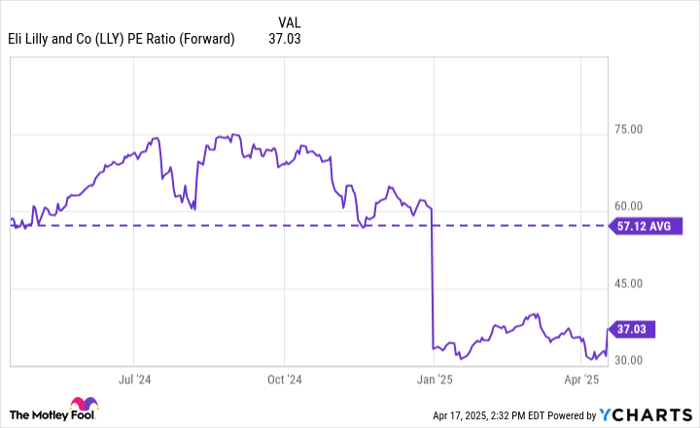
LLY PE Ratio (Forward) data by YCharts.
While short-term fluctuations may impact financial returns due to tariffs, Eli Lilly’s diversified portfolio and strategic positioning in various markets underscore a promising long-term perspective.
Should You Invest $1,000 in Eli Lilly Stock Now?
Before making a $1,000 investment in Eli Lilly, take note:
The Motley Fool Stock Advisor team recently highlighted their 10 best stock picks for current investors, and Eli Lilly was not among them. These selected stocks are projected to generate significant returns moving forward.
For instance, if you had invested $1,000 in Netflix when it made the list on December 17, 2004, your investment would be worth about $524,747 by now. Similarly, a $1,000 investment in Nvidia on April 15, 2005, could have grown to approximately $622,041!*
It’s important to bear in mind that the average return for Stock Advisor is 792%, significantly surpassing 153% for the S&P 500. Don’t miss their top 10 list, available when you join Stock Advisor.
*Stock Advisor returns as of April 14, 2025
Adam Spatacco holds positions in Eli Lilly and Novo Nordisk. The Motley Fool recommends Novo Nordisk. For more information, see the disclosure policy.
The views and opinions expressed herein represent those of the author and do not necessarily reflect those of Nasdaq, Inc.