Federal Reserve’s Interest Rate Outlook: A Look at Market Reactions
In over 40 years in the markets, I’ve witnessed some notable trends and decisions. Recently, I’ve noticed a troubling shift in the perception of Federal Reserve leadership, with a “rockstar” status that began in the 1990s during Alan Greenspan’s tenure. It coincided with the dot-com boom, where the tech-heavy NASDAQ rose an astonishing 800% from 1995 to March 2000.
During that time, Greenspan issued a famous warning about “irrational exuberance” in the market. Wall Street interpreted his comments as a signal of impending doom. However, the market continued its upward trajectory for three more years, highlighting that the Fed’s predictions can sometimes miss the mark.
Fast forward to early 2001, when the federal funds rate was around 6.5%. The Fed’s forecast indicated a sluggish economy that would strengthen throughout the year. Unfortunately, the dot-com bubble burst, and the aftermath of the 9/11 events led to multiple interest rate cuts, lowering the rate to a historical low of 1.75%.
In December 2018, the Fed expected to raise interest rates twice in 2019. However, by mid-2019, it had reversed course, cutting rates three times due to economic concerns from the ongoing U.S.-China trade war.
Recently, the Fed convened for its latest meeting. While no major changes were anticipated regarding key interest rates, investors closely monitored the results for clues about upcoming rate cuts.
The Fed’s Recent Decisions
On Wednesday, the Fed opted to keep interest rates unchanged in the 4.25% to 4.5% range. The dot plot forecasted two rate cuts for this year—consistent with the previous year. Notably, eight members of the Federal Open Market Committee (FOMC) anticipated only one key rate cut.
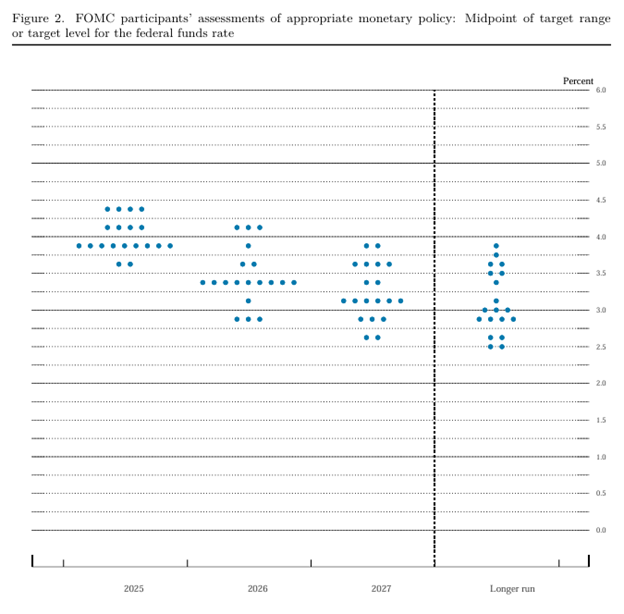
The Fed’s current economic outlook reflects a projected unemployment rate of 4.4% and an expected annual growth rate of 1.7%, down from the previously estimated 2.1%. Additionally, the impact of President Trump’s tariffs on inflation and consumer sentiment has raised significant concern.
Fed Chair Jerome Powell underscored this issue in his press conference, calling a sharp increase in long-term inflation expectations by the University of Michigan an “outlier.” He acknowledged that inflation is rising partly due to tariffs but suggested that any inflationary effects would likely be “transitory.”
Despite recognizing tariffs as a potential obstacle to controlling inflation, Powell assured that the Fed is ready to adapt its policies as needed, stating, “We think our policy is in a good place to react to what comes.”
Expectations for Future Rate Cuts
While the Fed forecasts two rate cuts, I predict there will be four. We are approaching a global interest rate decline, as evidenced by the European Central Bank’s two recent cuts and the Bank of England’s one cut this year. Furthermore, bond yields in China have dropped below Japan’s 30-year bond, driven by deflation stemming from a declining population and an oversupply in sectors like electric vehicles and electronics.
The reality is that as global rates decrease, the Fed will likely follow suit rather than resist market trends. However, it seems the Fed’s focus is short-term, lacking a long-range view.
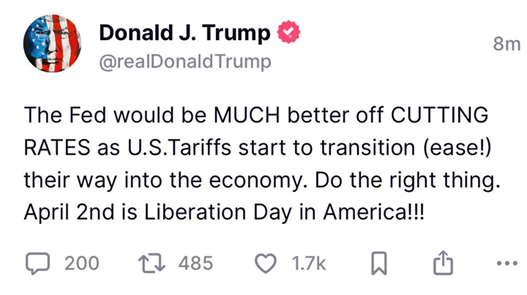
In a related note, President Trump expressed his opinions following the Fed’s decision.
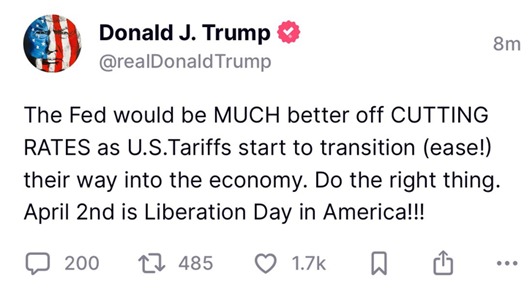
It’s my belief that the President’s views may ultimately align with market dynamics. As global interest rates keep falling, the Fed might find itself compelled to cut rates more aggressively than indicated on the dot plot.
Strategies for Profit Amid Market Volatility
In light of the current market turbulence, many investors are feeling uncertain. However, I assert that the tariffs serve as a tactical approach under the Trump 2.0 Administration, aimed at increasing job growth in America through onshoring.
I anticipate a significant growth surge due to pro-business policies, particularly regarding the artificial intelligence sector. President Trump aims to eliminate barriers to AI development, which I term the “Trump/AI Convergence,” creating substantial investment prospects.
To capitalize on these trends, I propose a practical trading strategy that generates regular income without relying on dividends or complex options. This approach utilizes my proven Stock Grader system (subscription required) to deliver consistent gains, allowing for realized cash flow from partial sales on positions like:
- $2,710 from Sitio Royalties Corp. (STR)
- $3,375 from CECO Environmental Corp. (CECO)
- $2,783 from Catalyst Pharmaceuticals, Inc. (CPRX)
- $7,135 from Builders FirstSource (BLDR)
- And more…
Staying informed and prepared can enable investors to find opportunities, regardless of market fluctuations.
Unveiling My Strategy for Profit in the Trump/AI Convergence
Discover how I plan to capitalize on the convergence of Trump’s influence and artificial intelligence in my upcoming presentation. This strategy aims to leverage current trends for potential financial gains.
As a special addition, you’ll also gain access to an exclusive podcast. In this podcast, I provide insights into how the Trump and AI convergence is developing, along with my forecasts for the year 2025.
Sincerely,

Louis Navellier
Editor, Market 360
The Editor hereby discloses that as of the date of this email, the Editor, directly or indirectly, owns the following securities that are the subject of the commentary, analysis, opinions, advice, or recommendations in, or which are otherwise mentioned in, the essay set forth below:
Catalyst Pharmaceuticals, Inc. (CPRX) and CECO Environmental Corp. (CECO)