Federal Reserve Maintains Current Rate Amidst Expectations of Three Rate Cuts in 2024
On the frontlines of the financial battlefield, the Federal Reserve stood firm today, holding the target rate steady at 5.25% – 5.50%. Investors, eagerly waiting in the wings, had already predicted this move.
Hot on the burning tongues of analysts was the impending Dot Plot recalibration. Rumors swirled, fueled by recent inflation spikes, that the Fed might reduce its forecasted interest rate cuts for the year, causing the market to quake in its proverbial boots.
Fortunately, the sky did not fall. The refreshed Dot Plot, unveiled today, proudly displays three planned quarter-point interest rate reductions in 2024.
Like a well-oiled machine, the stock market threw a party. S&P led the charge past the 5,200 mark, while the Dow danced to its own high notes, and Nasdaq leaped 1.2% for a record-breaking finish.
Delving Deeper into the Dot Plot Territory
Imagine, if you will, the Dot Plot – a visual tapestry that weaves together each committee member’s clandestine vision of future interest rates. Every three months, the Fed illuminates this plot.
During the December FOMC powwow, the Dot Plot foretold a median prophecy of three quarter-point rate slices in 2024.
These prophesied cuts stand as the cornerstone of the bullish narrative in 2024. Historically, stocks flourish in the fertile soil of falling interest rates, a scenario not of necessity but of opportunity.
Yet, as the recent inflation tremors rippled through January and February, the nagging question hung in the air like a thick mist – would Chairman Powell and his posse backpedal on their rate-cut pledges?
But lo and behold, it wasn’t to be.
Unfazed by inflation’s fiery breath, Powell, in his live address, remarked, “I think [the hotter inflation data] haven’t really changed the overall story, which is that of inflation moving down gradually on a sometimes bumpy road toward 2%.”
The market heaved a collective sigh of relief as Powell threw a bone, hinting at a potential slowdown in the Fed’s balance sheet runoff. The bulls rejoiced as Powell articulated, “The general sense of the committee is that it will be appropriate to slow the pace of run-off fairly soon, consistent with the plans we’ve previously issued.”
When queried about robust job growth influencing interest rate decisions, Powell coolly replied, “In and of itself, strong job growth is not a reason for us to be concerned about inflation. No, not all by itself.”
The bulls were jubilant. The flag of the bull market flies proudly in the winds of uncertainty.
A Glimpse into the Future: Anticipating Relief for the Ailing U.S. Consumer
Guided by the stars of the updated Dot Plot, the odds seem stacked in favor of the Fed’s inaugural rate cut in June.
The dearest hope rests on the weary shoulders of the U.S. consumer, weathered but resilient, plagued by fractures gradually widening.
Doubt not the fortitude of the consumer – a force as fickle as a March breeze. Time and again, their strength has defied the pundits’ predictions.
Amidst the jubilation of market milestones, let’s not turn a blind eye to the shadows cast by grim tidings concerning the U.S. consumer, making the notion of a June rate cut a beacon of hope.
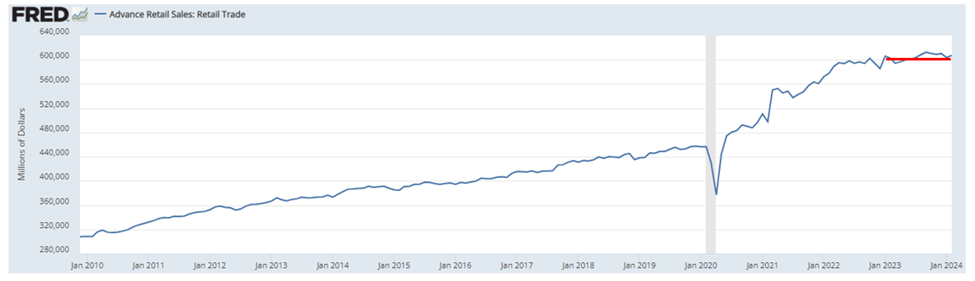
Let us set our sights on retail spending – the pulsating heart of the American economic engine.
The Financial Times paints a grim picture: “Evidence is mounting that many Americans have reached their limit for tolerating higher prices, raising questions about how much consumer expenditures will continue to power US economic growth this year.”
Retail sales in February, a paltry 0.6% increase from the previous month, has sent ripples of concern through the financial landscape.
As Steve Ricchiuto, the chief economist at Mizuho Securities, aptly put it, “The economy is losing some momentum.”
Peering into the abyss, we confront an unsettling tableau. The relentless march of retail sales flattens, a red line etching a year-long stagnation. The silence is deafening, mirroring the ominous calm before a tempest.
The Financial Struggles of consumers Revealed Through Record Credit Card Defaults and Low Savings Rates
For more than a decade, Bankrate, the personal finance site, has been surveying Americans on their savings habits. This year’s results are in, and the numbers paint a revealing picture. Savings rates have reached an all-time high of 3.8%, reflecting a significant shift in financial behavior. While not an absolute low, it certainly treads within concerning territory.
Credit Card Default Rates Soar to New Highs
Contrastingly, the current economic landscape is marred by a surge in credit card defaults. A recent report from the research firm Game of Trades highlights how small lenders are grappling with the highest default rates seen since 1991. The visual representation below underscores the severity of this alarming trend.

Source: Game of Trades
Meanwhile, retirement accounts are also taking a hit. According to recent findings from Vanguard Group, a record share of 401(k) account holders resorted to early withdrawals last year for financial emergencies. The statistics paint a bleak picture, with emergency distributions hitting consecutive record highs. The mounting financial pressures are evident, with nearly 40% of those tapping into their accounts to prevent foreclosures.
Global Financial Strains Amid Rising Corporate Defaults
The financial troubles extend far beyond U.S. borders, with companies worldwide grappling with heightened debt costs and dwindling revenues. S&P Global Ratings reports a stark increase in corporate defaults, reaching a level unseen since the global financial crisis in 2009. The growing number of defaults, predominantly in the U.S., is causing concerns among analysts, with European bankruptcies on the rise.
Amid these unsettling revelations, what actions should investors take?
Navigating the Turbulent Financial Waters
Amidst the tumultuous financial climate, two key factors offer some solace. The Federal Reserve maintains its course for three rate cuts this year, providing a glimmer of hope for market stability. Additionally, the imminent end of peak target rates signifies a potential upswing for stocks, historically performing well in rate-cutting environments.
However, caution is warranted. While the upcoming rate cut and promising earnings reports may offer temporary relief, it’s crucial to exercise prudence in investment decisions. Delving into high-conviction stocks, adjusting stop-loss levels, and recalibrating portfolio exposure are prudent steps in navigating the uncertain financial waters.
Despite the challenges faced by consumers and companies alike, there lies an opportunity for astute investors to capitalize on the resilience of the market. With careful maneuvering and strategic planning, there remains potential for growth amidst the financial turmoil. In the wise words of Jeff Remsburg, let’s make the most of these circumstances while we can.
Take every precaution, stay informed, and always be prepared for the unexpected shifts in the financial landscape.