“`html
U.S. Jobs Report Exceeds Expectations Amid Mixed Economic Signals
This morning, the U.S. payrolls report showed surprising strength.
In April, the U.S. economy added 177,000 jobs, exceeding the expectation of 133,000 jobs. The overall unemployment rate held steady at 4.2%.
Average hourly earnings increased by 0.2%, just shy of the anticipated 0.3%. The annual growth rate stood at 3.8%, a touch below the 3.9% forecast.
This data suggests that the economy remains steady and relatively strong, although caution is warranted.
We must consider yesterday’s weaker weekly jobless claims, which were not included in today’s figures.
That report revealed an unanticipated rise in initial unemployment claims, with first-time filings for unemployment insurance reaching 241,000—up 18,000 from the previous period and above the estimate of 225,000.
Some analysts believe this increase may be related to spring break for public schools. Still, the trend in continuing unemployment claims points to underlying economic weakness.
Here’s a summary from CNBC:
Continuing claims, which lag by a week and give a broader view of layoffs, rose to 1.92 million—an increase of 83,000, the highest level since November 13, 2021.
Despite these rising claims, the recent jobs data can be interpreted as a net positive for the economy.
How Does This Impact the Federal Reserve?
The latest data does not suggest a dire need for interest rate cuts.
Federal Reserve Chairman Jerome Powell is likely cautious after his 2021 mischaracterization of inflation as “transitory” led to rampant inflation. Given that context, Powell may be reluctant to cut rates prematurely, which could reignite inflation.
President Trump has been vocal on social media regarding his stance:
Just like I said, and we’re only in a TRANSITION STAGE, just getting started!!! Consumers have been waiting for years to see pricing come down. NO INFLATION, THE FED SHOULD LOWER ITS RATE!!!
This ongoing pressure from Trump could backfire. His calls for lower interest rates may harden Powell’s stance, as the Fed Chair might not want to appear swayed by politics.
In light of the current data, Powell might choose to delay a decision for another month to reinforce the Fed’s independence.
Investor Sentiment: Louis Navellier Advocates for Rate Cuts
In yesterday’s Flash Alert for Growth Investor, Louis Navellier expressed optimism:
On Fox Business yesterday, Scott Bessent stated that the Fed should consider rate cuts.
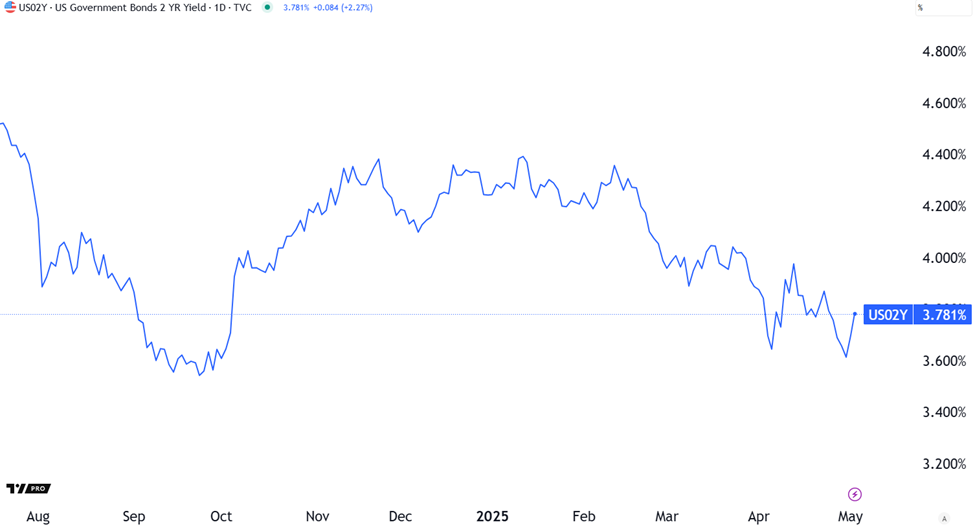
The two-year Treasury yield is at its lowest since last September and significantly below the federal funds rate, suggesting that multiple rate cuts may be warranted.
Following the jobs report, Treasury yields changed slightly. They are currently at least 50 basis points lower than the federal funds rate.
The two-year Treasury yield remains restrictive at 3.78%, while the fed funds target rate sits in the range of 4.25% – 4.50%, indicating potential for lower rates ahead.
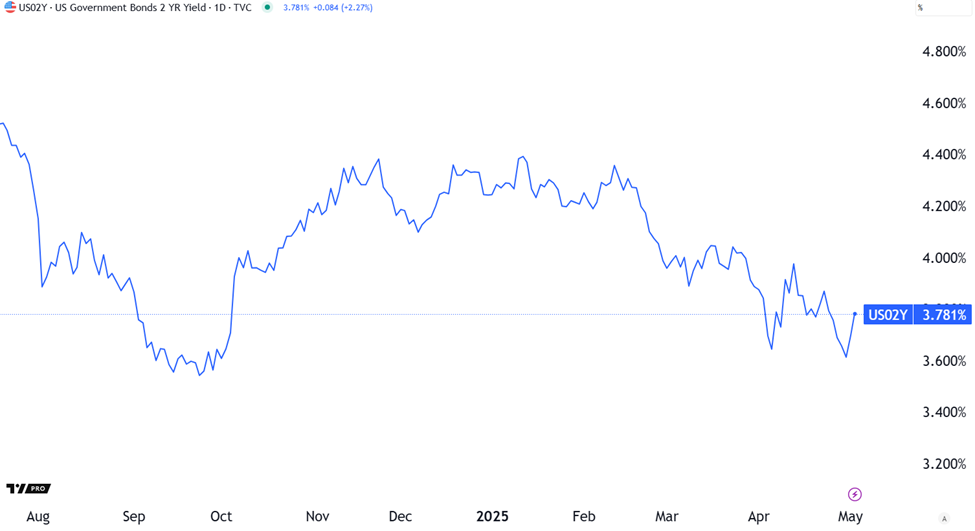
Source: TradingView
Throughout history, Louis has asserted that the Fed typically avoids conflicting with market rates. With the current conditions, he forecasts four rate cuts this year, driven largely by a collapse in interest rates in Europe.
He added, We’re going to get a Fed rate cut in May. If we don’t, [the Fed members are] clinically insane – they’re not looking at the data. The pressure for them to cut will intensify as market rates decline.
While some members of the Fed may lack qualifications, they generally move in consensus and should naturally follow market rates.
My key message is that once the Fed starts cutting, confidence will return, and everything will stabilize.
Monitoring Job Market Trends Amid Weakness
Recent data from Challenger, Gray & Christmas highlighted mixed signals in the job market.
Firstly, the number of planned job cuts dropped significantly by 62%, totaling 105,441 last month.
Conversely, layoffs surged by 63% compared to last year, marking the highest number in five years for April.
This spike is not entirely attributable to governmental job cuts, as job reductions were seen across various sectors.
Here’s what Andrew Challenger noted:
While government cuts are notable, we observed job reductions spanning multiple sectors last month.
Employers cite economic conditions and advancements in technology as reasons for slow hiring and cautious staffing plans.
“`# Rising Layoffs and Weak Consumer Sentiment Signal Economic Concerns
## Record Layoffs Announced in 2025
According to the Challenger, Gray & Christmas report, U.S. employers have revealed a staggering 602,493 layoffs so far this year, marking the highest year-to-date total since 2020. This figure represents an 87% increase compared to the 322,043 layoffs announced during the same period in 2024.
## Declining Sales at McDonald’s Indicate Consumer Weakness
McDonald’s serves as a bellwether for consumer spending, especially among lower-income groups. The fast-food chain recently reported a 3.6% decline in U.S. same-store sales for the first quarter, the largest drop since the onset of COVID-19 lockdowns. This decline marks the second consecutive quarter of falling sales.
CEO Chris Kempczinski emphasized the economic uncertainty affecting consumers, stating:
> “Consumers today are grappling with uncertainty.”
The situation appears dire, particularly for low-income consumers, whose traffic to quick-service restaurants has decreased nearly 10% compared to the previous year. Additionally, the decline is not limited to lower-income consumers; middle-income traffic has also seen significant drops, suggesting a broader economic strain.
Executives from Chipotle, PepsiCo, and Starbucks have echoed these sentiments. Chipotle’s CEO Scott Boatwright noted that economic concerns primarily drive consumers’ reduced visit frequency to restaurants, while PepsiCo’s CFO Jamie Caulfield remarked on declining consumer sentiment compared to three months ago. Starbucks CEO Brian Niccol described the current economic environment as “tough” for consumers.
## Credit Card Data Signals Financial Pressure
A recent report from Fortune highlights growing financial stress among lower-income Americans. Data shows that over 11% of customers at major banks made only minimum payments on their credit card bills in the fourth quarter of 2024, the highest rate recorded since tracking began 12 years ago.
As we observe a market rally and appreciate positive payroll data, it is essential to pay attention to these worrying indicators.
## Potential Tariff Negotiations with China
In a more encouraging development, a spokesperson from China’s Ministry of Commerce indicated the possibility of tariff negotiations with the United States. This aligns with China’s aim to maintain a favorable diplomatic stance and reinforces recent openness to discussions.
The spokesperson stated:
> “If we fight, we will fight to the end; if we talk, the door is open…”
They further noted that U.S. officials had shown willingness to engage in tariff discussions but emphasized that the U.S. must demonstrate sincerity in negotiations.
Additionally, The Wall Street Journal reported that Chinese officials are exploring how to address U.S. demands regarding the control of fentanyl-related chemicals. Discussions remain ongoing, though there is a desire for softer U.S. trade pressures.
While the invitation to talks may not be warm, it is a step away from outright rejection.
## Recap on Job Data from Challenger, Gray & Christmas
Andrew Challenger’s earlier remark reflects a trend worth noting:
> “Though the Government cuts are front and center, we saw job cuts across sectors last month.”
Challenger mentioned that companies are cautious about hiring, attributing job cuts to the economy and advancements in new technologies, particularly in robotics and AI.
As these discussions continue, it serves as a reminder of the dual pressures facing both the job market and broader economic landscape.