Trump’s Critique of Powell amid Bond Market Turmoil and Rising Debt
Editor’s Note: Our InvestorPlace offices are closed tomorrow for Good Friday.
If you need assistance from our Customer Service team, they’ll be happy to assist you when we re-open on Monday.
Have a wonderful Easter Weekend!
Trump’s Comments on Jerome Powell
Today, President Trump voiced strong criticism of Federal Reserve Chair Jerome Powell on Truth Social, stating:
The ECB is expected to cut interest rates for the 7th time, while ‘Too Late’ Jerome Powell continues to issue reports that are always too late and wrong. Oil prices are down, groceries (even eggs!) are down, and the USA is profiting from tariffs.
Powell should have lowered interest rates long ago, and he certainly should do it now.
His termination cannot come fast enough!
As discussed in our Digest, Trump is eager for lower interest rates. This might be tied to the trillions in government debt maturing within the next 18 months, or perhaps he wants to support the economy and the struggling stock market.
However, achieving lower rates through Powell may not guarantee Trump’s expected outcomes. Notably, the Federal Reserve controls only the federal funds rate—a short-term lending rate. The significant factor affecting mortgage rates and the broader economy is the ten-year Treasury yield, which is influenced by market conditions.
According to notable investor Louis Navellier, one group currently holds significant sway over the market.
The Role of Bond Vigilantes
Louis’ favorite economist, Ed Yardeni, coined the term “Bond Vigilantes” in the 1980s. This term describes bond investors who sell Treasurys when they view fiscal or monetary policies as irresponsible, such as excessive government spending. By selling bonds, they raise yields, effectively increasing borrowing costs for the government.
These investors act as a market enforcing discipline when fiscal policies stray off course.
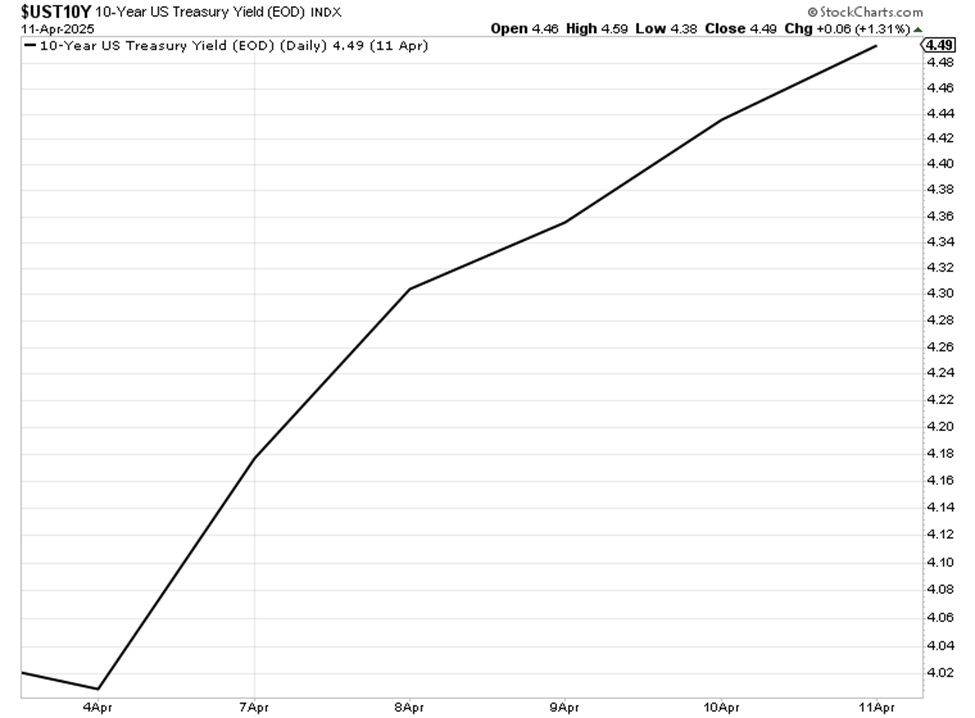
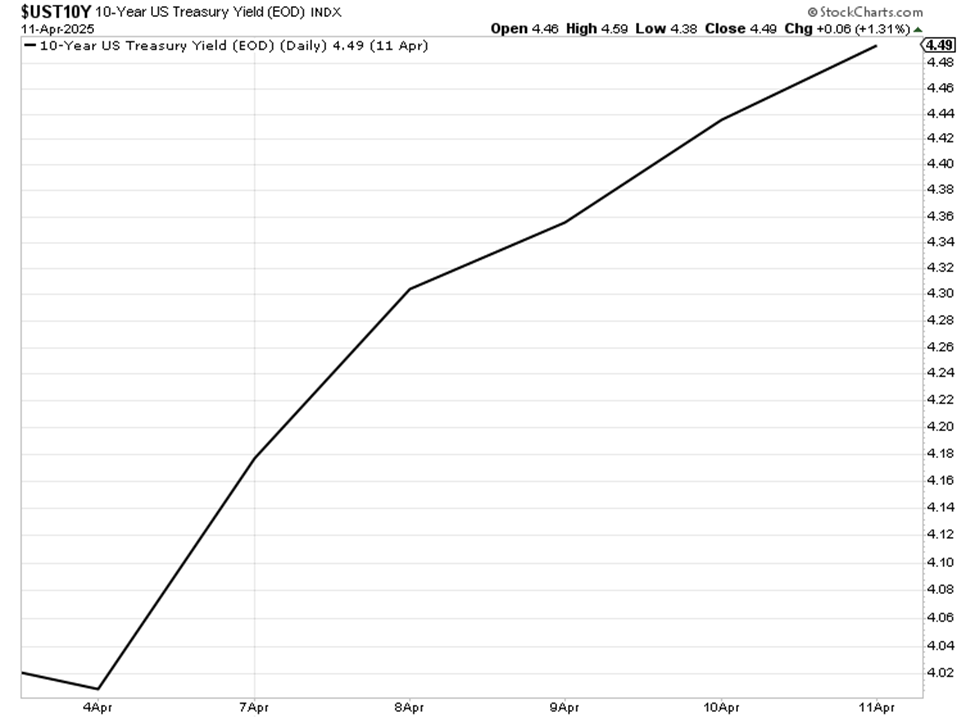
Recently, Bond Vigilantes made headlines with a historic spike in the ten-year Treasury yield. Last week, they dramatically sold off the ten-year Treasury, causing its yield to jump from under 4.00% to around 4.50%. This marked the largest weekly increase in over a decade. You can view the changes in the chart below.
Source: StockCharts.com
In yesterday’s episode of the Special Market Podcast from Growth Investor, Louis stated:
Last week’s movements were surprising.
The key point is that Bond Vigilantes are currently in control—these major institutional Treasury investors.
As a result, the U.S. dollar has declined almost 10% this year, with Treasury yields rising due to Bond Vigilantes selling off Treasuries.
This dynamic suggests that it’s the Bond Vigilantes, not President Trump, who are directing the course of action.
As these investors shunned U.S. Treasuries, President Trump found it necessary to implement a 90-day suspension on reciprocal tariffs.
Concerns of the Bond Vigilantes
The pressing question for Bond Vigilantes might be, “What aren’t they worried about?”
The U.S. budget deficit has surged to $1.83 trillion last year, or 6.4% of the nation’s economic output, the highest level aside from the COVID-19 pandemic. For the current fiscal year 2025, the deficit has also exceeded $1.3 trillion in just the first half, marking the second-highest six-month deficit ever recorded after the pandemic.
National debt continues to rise, now approaching $37 trillion and increasing by over $1 trillion every 100 days. The debt-to-GDP ratio stands at 123%, a figure deemed unsustainable in the long run, threatening potential economic or currency collapse.
Government interest payments, based on debt and high interest rates, compound these challenges. According to the non-partisan Peter G. Peterson Foundation:
The Congressional Budget Office (CBO) expects interest payments to reach $952 billion in fiscal year 2025, with a rapid increase projected in the coming decade…
By 2026, interest costs will surpass the post-World War II high of 3.2% relative to GDP…
Currently, the federal government allocates more funds to interest than to financing:
- Defense
- Medicaid
- Federal spending on children
- Income security programs, such as SNAP and tax credits
- Veterans’ benefits
This year, interest payments are expected to exceed federal spending on Medicare, with Social Security being the only larger program beyond net interest.
Additionally, Trump’s proposed tax plan raises concerns for the Bond Vigilantes. Understandably, governments primarily fund spending through taxes and debt (via issuing Treasurys). If President Trump’s…
Tax Cuts and Bond Vigilantes: A Financial Dilemma Ahead
If the proposed tax plans succeed in Congress, there will likely be a decrease in tax revenues.
The Committee for a Responsible Federal Budget projects these tax cuts could increase the U.S. national debt by $7.75 trillion over the next ten years.
This increase would necessitate greater reliance on debt issuance to fulfill government spending commitments.
Consequently, the focus turns to debt, specifically Treasurys, and brings us back to the bond vigilantes, who are responding to perceived economic mismanagement by pushing Treasury yields higher.
Foreign Bond Vigilantes Drive Selling Pressure
It’s important to note that the monthly Treasury data is often delayed, making it difficult to pinpoint exactly who was selling bonds last week. However, there’s speculation that the selling isn’t exclusive to U.S. investors.
The primary foreign holders of U.S. debt are China and Japan.
China may be motivated to sell U.S. Treasurys, and some analysts believe they are playing a strategic role in the market.
As reported by CNBC:
“I think China is actually weaponizing the Treasury holdings already,” stated Chen Zhao, chief global strategist at Alpine Macro.
“They sell U.S. Treasurys and convert the proceeds into Euros or German bunds. This aligns with recent market behavior,” he added.
Interestingly, while long-dated Treasurys faced a sell-off last week, Germany’s bunds saw a drop in yields.
However, there is resistance to this viewpoint.
Selling U.S. bonds typically results in capital returning to China in yuan, which would strengthen the currency—counterproductive for Beijing, as it seeks to mitigate the impacts of tariffs imposed by Trump.
In Japan, Finance Minister Katsunobu Kato has asserted that Japan will not use its Treasury holdings as leverage against Trump:
“We manage our U.S. Treasury holdings from a standpoint of preparing for possible exchange-rate intervention in the future,” he stated.
Nonetheless, it appears that Japanese insurer Nippon Life owns substantial amounts of Treasurys, and they may also be behind recent selling activity.
As noted by BCA Research’s Garry Evans:
“It’s easy for the Japanese government to say they won’t sell U.S. Treasurys, but it’s not the government that owns them; it’s Nippon Life,” he remarked.
“If these insurers are worried about U.S. policy uncertainties and seek to lessen their exposure, there isn’t much the government can do.”
This suggests that bond vigilantes are not limited to the United States.
Regardless of who is executing the selloff, the reality is that major investors have been withdrawing from the 10-year Treasury market.
Concerns of Bond Vigilantes: The Worst-Case Scenario
Imagine a situation where a relative continually borrows money but spends it extravagantly. Eventually, when you realize this pattern, you will either demand higher returns or cease lending altogether.
The bond vigilantes have already started pursuing the “higher return” strategy, and hedge fund billionaire Ray Dalio fears a more dire outcome—lenders may stop wanting to finance U.S. government debt.
Dalio elaborated during the CONVERGE LIVE event in Singapore:
“At some point, the U.S. will have to sell a quantity of debt that the world is unwilling to purchase.”
Dalio considers this an “imminent” concern of “paramount importance.”
Wharton Business School finance professor Joao Gomes pointed out:
“The critical factor about debt is the necessity of having buyers.”
“We used to rely on China, Japanese investors, and the Federal Reserve to absorb this debt. Now, those players are dwindling and even selling.”
“If potential buyers decide they are unsure about the viability of these investments, they could demand higher interest rates, leading to significant market repercussions.”
Dalio warned that if the market lacks buyers for U.S. Treasurys, we might witness “shocking developments in how this debt will be managed.”
Possible scenarios could include debt restructurings, pressure from Washington on foreign nations to purchase U.S. debt, or even debt monetization.
While he did not specify, historical economic analysis indicates that debt monetization carries the risk of hyperinflation.
Navigating Economic Uncertainty
Despite Dalio’s warnings about an imminent crisis, it is improbable that a significant financial catastrophe is on the immediate horizon.
While we recognize the value of Dalio’s insights, it is noteworthy that he has been sounding alarms about possible economic doom for several years. Some events may eventually come to pass, but it is common for governments to implement measures to delay such outcomes.
Shifting focus to what you can control is advisable rather than worrying about factors outside your influence.
Understanding overarching macroeconomic trends can assist in making informed market decisions but should not paralyze your actions.
As Louis emphasizes, adhere to the “iron law” of the Stock market:
“Stock price trends may diverge from earnings trends temporarily, but over time, if companies consistently grow their cash flow, their share prices are likely to rise.”
This outlook keeps Louis optimistic during the current earnings season, which has just launched. By focusing on fundamentally sound companies with strong earnings power, investors often find that earnings season yields positive returns.
Exploring AI for Market Navigation
Recently, Keith Kaplan, CEO of our partner TradeSmith, hosted an informative live event focused on AI’s role in market analysis.
During this event, attendees learned about TradeSmith’s AI-driven algorithm, An-E (short for Analytical Engine), designed to forecast stock prices one month ahead and assess the level of confidence in those predictions. This technology proves beneficial in both bullish and bearish market conditions.
You can access a free replay of the event, which includes back-test examples. Plus, five of An-E’s most bearish forecasts are shared—stocks anticipated to experience significant declines shortly. Just Click here to view.
Reflecting on Recent Fed Actions
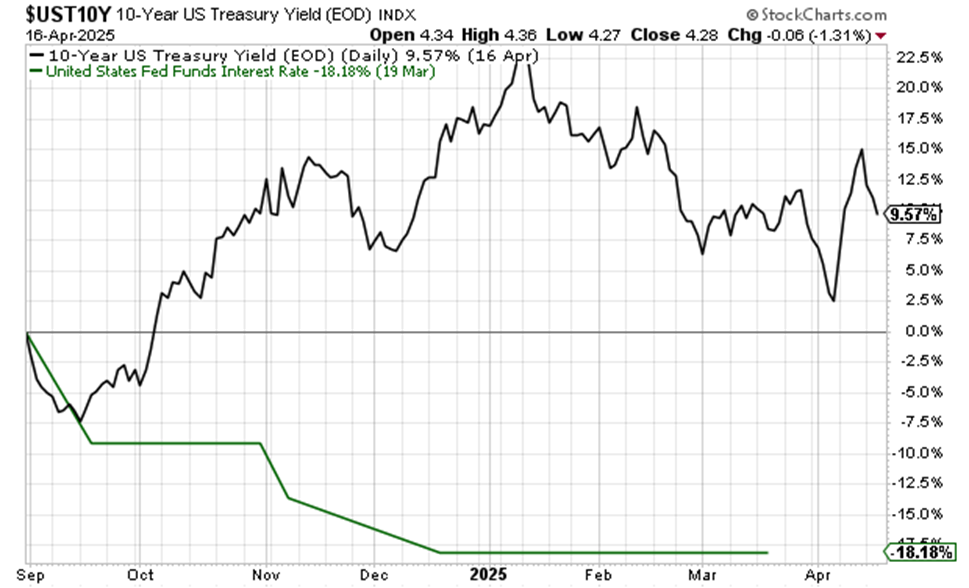
Last September, the Federal Reserve initiated interest rate cuts as advocated by Trump.
However, contrary to expectations, the 10-year Treasury yield did not decrease.
As illustrated in the chart below, Treasury yields diverged from the Fed funds rate, with the 10-year yields rising instead.
Source: StockCharts.com
In conclusion, while Trump may direct attention toward Powell, it is evident that the Bond Vigilantes are the ones shaping the market.
Best wishes,
Jeff Remsburg