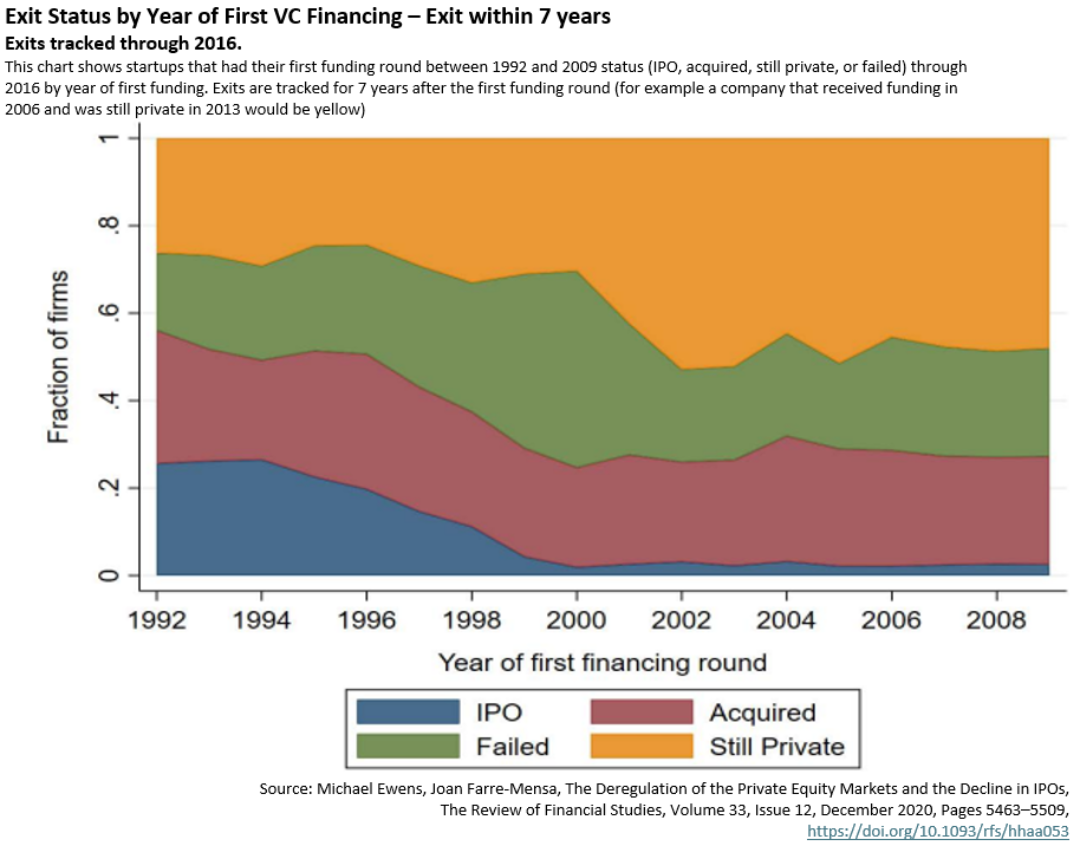
The U.S. initial public offering (IPO) landscape has undergone significant transformation, with companies now staying private longer and entering the public market as larger, more mature entities. The share of startups that eventually go public has plummeted from over 25% in the late 1990s to just 2% today, while the median age of companies at IPO has doubled. Additionally, total capital raised by late-stage private startups has tripled.
As of recent data, just over 26% of companies that first received venture capital (VC) funding in 1994 went public within seven years, contrasting sharply with only 2% of those funded in 2009 reaching the same milestone by 2016. Acquisition and failure rates have remained relatively stable at around 25% and 20-25%, respectively, highlighting a stark decline in IPO activity rather than a general decrease in company viability.
Executives cite liability and regulatory burdens as the primary obstacles inhibiting the IPO process, according to a recent survey from Bloomberg. Addressing these barriers could enhance market conditions and encourage companies to transition to public status more readily.
5 Stocks Our Experts Predict Could Double In the Next Year
By submitting your email, you'll also get a free pivot & flow membership. A free daily market overview. You can unsubscribe at any time.