The Longshoremen’s Standoff: Inflation, Automation, and Economic Ripples
The United States is currently in the throes of a major labor dispute as members of the International Longshoremen’s Association (ILA) have initiated a strike, putting forth demands for a more favorable labor contract from the United States Maritime Alliance. The consequences are dire, with JPMorgan predicting potential daily economic losses amounting to a staggering $5 billion as cargo remains immobile at ports, setting off a chain reaction of supply disruptions likely to impact the upcoming holiday shopping season.
This standoff casts a shadow over two critical facets: inflation and automation.
ILA Strike: Inflation Alarm Bells Ringing
Economically speaking, the ramifications of the ILA strike are far-reaching. A halt in the movement of various goods across the docks of major cargo ports spanning from Maine to Texas is anticipated. The list of affected items includes bananas, European beverages, apparel, furniture, as well as crucial parts essential for maintaining US factory operations. The disruption has the potential to fuel inflation, leading to possible shortages and consequent price hikes, all while complicating the Federal Reserve’s interest rate trajectory.
The Automation Conundrum: The ILA Strike Beyond Wages
The ILA strike represents more than a quest for improved wages – it’s a battle against the encroachment of automation in dock operations. As dockworkers push back against the adoption of automation, a productive dialogue is imperative to ensure a smooth transition that upskills workers for future opportunities in a rapidly evolving landscape dominated by technology and robotics.
Manufacturing Contraction: ISM Report Highlights Sectoral Struggles
New data from the Institute of Supply Management (ISM) unveils a grim reality for the manufacturing sector, which has contracted for the sixth consecutive month. With the Manufacturing Purchasing Managers Index (PMI) stagnant at 47.2, according to economists’ expectations, the weak demand and dwindling output raise concerns about the economy’s trajectory, especially amidst the ongoing ILA strike complicating supply chains further.
Japanese Market Jitters: Ishiba’s Victory and its Financial Ripples
The recent prime ministerial election in Japan, resulting in Shigeru Ishiba’s victory, has triggered volatility in the Nikkei stock index. Ishiba’s stance on raising interest rates to combat inflation, in contrast to his opponent’s preference for near-zero rates, has stirred market apprehensions reminiscent of a previous yen carry trade fallout. This unfolding saga underscores the delicate dance of monetary policy decisions and their profound impact on investor sentiment and market stability.
Crypto Turmoil: Bitcoin Struggles to Hold Ground
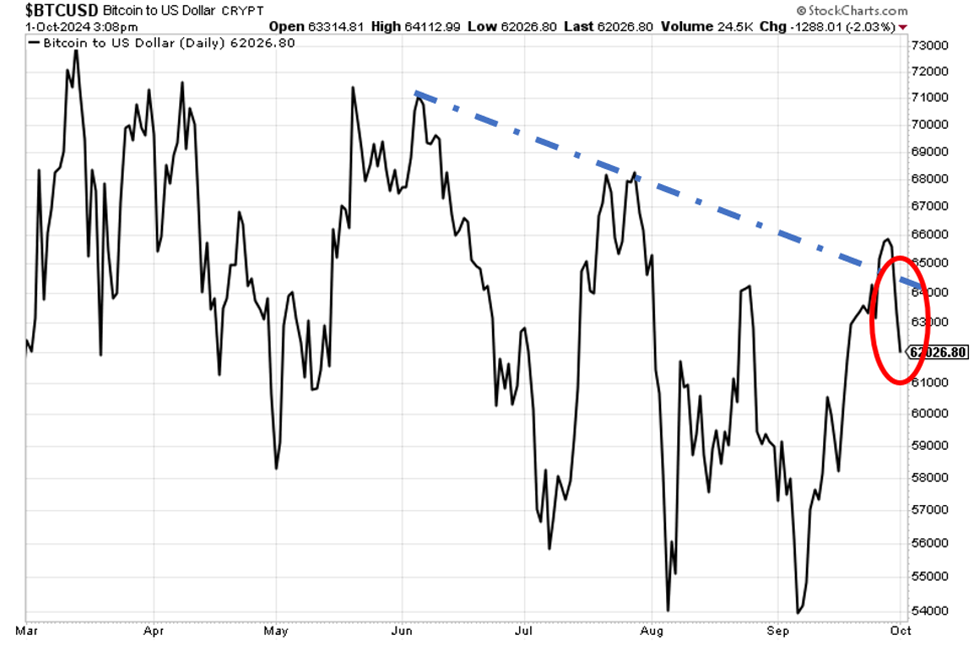
The crypto sphere witnessed a turbulent phase as Bitcoin failed to maintain a crucial support level, signaling potential turbulence in the digital asset realm. Market experts had been eyeing a pivotal threshold for Bitcoin’s resurgence, making it a crucial juncture with broader implications for cryptocurrency investors navigating a landscape of volatility and uncertainty.
The Unraveling of Bitcoin and the Future of Gold Amidst Government Financial Strain
The recent turbulence in the cryptocurrency market has sent shockwaves through the investment community. Bitcoin, the poster child of the digital currency world, has struggled to maintain its ground as it slipped below the crucial $64,000 level. Investors who were riding the surge were left grasping for stability as Bitcoin plummeted to around $62,000.
A Technical Blow
The $64,000 level has emerged as a touchstone for Bitcoin, marking a significant point in its trajectory. Historically, this level has been indicative of Bitcoin’s downward trend line since the summer, acting as a pivotal milestone for traders and analysts alike.
Downward Trends and Seasonal Insights
Despite the recent dip, there is a glimmer of hope as Bitcoin could potentially reverse course in the coming days. However, the loss of this critical level signals potential weakness ahead, with indications pointing towards a possible retest of $54,000, adding to the uncertainty of the market.
On the brighter side, a historical perspective on Bitcoin’s price performance reveals a promising seasonality pattern. While the current scenario may seem bleak, past trends suggest a potential boom in the future—offering a ray of optimism for crypto enthusiasts.
Government Financial Strain and the Rise of Gold
On the other end of the spectrum, the financial landscape governed by government policies and demographics paints a stark picture. With Americans becoming increasingly reliant on government aid, the strain on resources is palpable. Rising healthcare costs for seniors coupled with the demographic shift toward an aging population are fueling the growth of government spending.
This phenomenon, exacerbated by the ballooning national debt, sets the stage for a looming crisis. The core pillars of government expenditure, such as Social Security and Medicare, are under immense pressure, with limited avenues for sustainable solutions.
Investment Implications and Asset Resilience
Amidst this economic turmoil, investors are advised to seek refuge in assets that withstand the ravages of inflation and currency devaluation. Gold, with its historical resilience in turbulent financial times, emerges as a beacon of stability in a sea of uncertainty.
Although gold’s current all-time highs may see corrections in the short term, the long-term prospects remain bright. As governments grapple with mounting debts and devaluation pressures, owning assets like gold becomes paramount for preserving wealth.
As we navigate through these turbulent times, it is crucial to anchor investments in assets that can weather the storm of financial instability. Stay vigilant, choose wisely, and brace for the challenges ahead.