Market Divergence: Stocks Rise as Bonds Show Concerns
Analyzing Market Trends and Fiscal Policies
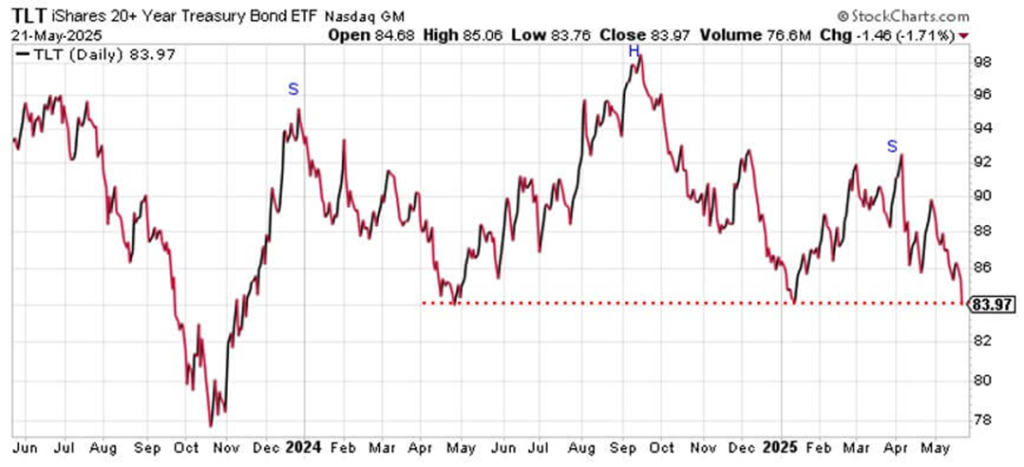
Master trader Jeff Clark identifies the iShares 20+ Year Treasury Bond Fund (TLT) as “the most dangerous chart in the financial markets.”
This fund tracks long-term Treasury Bonds.
Source: StockCharts.com
Clark states that as bond prices decline, longer-term interest rates increase, negatively impacting stock prices.
TLT is projected to decline, indicating a rise in long-term rates.
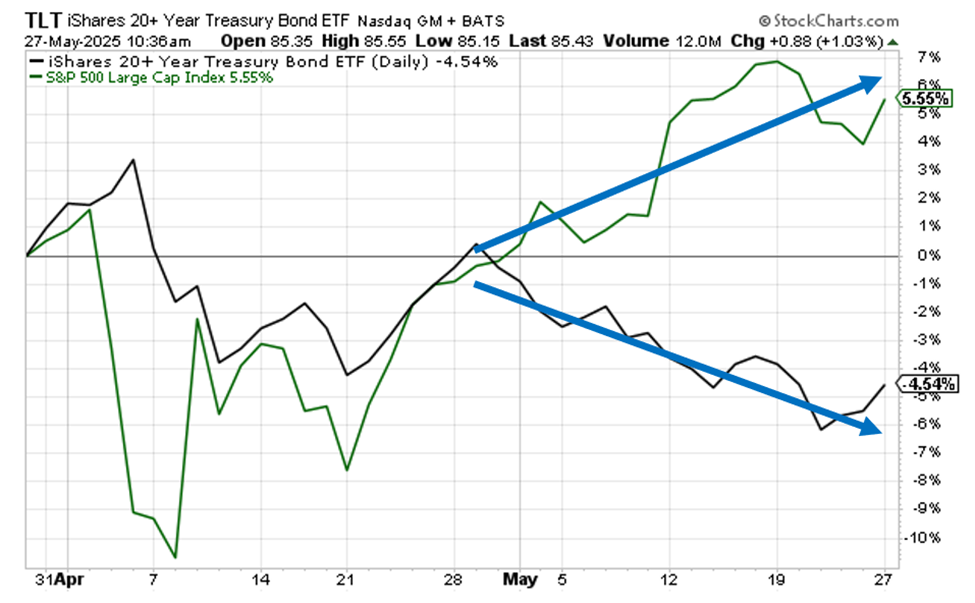
Despite TLT dropping 8% over six weeks, the S&P 500 has experienced significant gains.
This discrepancy raises questions about market signals.
Typically, stocks and Treasury bonds follow similar trends, making their current divergence notable.
In the two-month chart of TLT (in black) and the S&P (in green), both move in parallel until late April, when they sharply diverge.
Source: StockCharts.com
Analyzing Market Assessments
The main question arises regarding the differing market outlooks.
The stock market seems to expect favorable economic conditions, while bonds reflect pessimism.
According to Clark, bond yields are rising as the U.S. Treasury attempts to refinance trillions in maturing debt while planning new deficit spending.
This shift indicates the return of “Bond Vigilantes,” a term for investors who sell Treasurys due to perceived irresponsible fiscal policies.
Currently, concerns stem from President Trump’s proposed budget, estimated to add $3.8 trillion to national debt.
The U.S. budget deficit reached $1.83 trillion last year, or 6.4% of GDP, the highest shortfall outside of the COVID pandemic.
As of last month, the fiscal deficit exceeded $1.3 trillion for the first half of the fiscal year, the second-highest on record.
Overall national debt has surged nearly to $37 trillion, increasing by over $1 trillion every 100 days.
The current debt-to-GDP ratio stands at 123%, which is unsustainable in the long run.
Market Bulls Stay Optimistic
Concerns about fiscal responsibility are not new, but the stock market remains less than 5% below its all-time high.
Bulls argue that fears over federal spending do not merit a defensive posture.
Luke Lango suggests that the recurring cycle of debt fears is merely “Wall Street Panic Theater.”
Despite the growing national debt, the market has historically absorbed such challenges.
# Market Update: U.S. Debt and Inflation Signals Shape Economic Outlook
## Overview of U.S. Debt and Economic Resilience
U.S. debt has surged over 600%, supported by a robust economy. Companies like Amazon, Microsoft, Nvidia, Apple, Meta, and Tesla contribute significantly to this strength, generating trillions in market value and taxes that bolster government financing.
## Government Response to Trade and Inflation Concerns
Last Friday, Chicago Federal Reserve President Austan Goolsbee indicated that tariffs imposed by former President Trump could delay rate cuts until inflation shows clearer trends. On the same day, Trump proposed a blanket 50% tariff on all EU goods starting June 1 but later postponed this to July 9 following discussions with EU Commission President Ursula von der Leyen. The markets reacted positively to this news.
Economic uncertainty remains due to fluctuating trade policies, keeping the Fed cautious. Goolsbee noted that tariffs could potentially lead to stagflation, complicating the Fed’s monetary policy decisions.
## Bond Market Insights
Investors are eyeing long-term U.S. government bonds, represented by TLT, as a gauge for inflation outlook. If TLT slips below the $84 level, it may drop to the October 2023 low near $78, pushing long-term interest rates potentially above 5.6%. This could prompt significant shifts in both bonds and stock valuations.
As of Tuesday, TLT has risen alongside stocks, favoring bulls for the moment.
## Navigating the Stock Market: Insights from Louis Navellier
Investor Louis Navellier advises against binary thinking in stock and bond markets. He suggests that numerous sectors can thrive even amid uncertainty created by current policies. He notes that Trump’s economic initiatives are already in motion, favoring domestic production and strategic resources like energy and AI tech.
Navellier is hosting a “Liberation Day 2.0 Summit” to discuss sectors likely to excel, offering strategies to maximize returns.
## Avoiding Potential Market Pitfalls
Navellier warns investors to steer clear of businesses overly reliant on China, low-margin consumer brands, and companies dependent on subsidies, highlighting Kohl’s Corp. (KSS) as an example. Kohl’s struggles with competitive positioning have worsened due to recent tariff discussions, impacting its profitability.
He plans to identify 10 stocks that investors should consider avoiding or selling during the summit.
## Conclusion
Continued updates on TLT, inflation, and market dynamics will follow. Investors should monitor these developments closely to navigate potential opportunities and challenges ahead.
5 Stocks Our Experts Predict Could Double In the Next Year
By submitting your email, you'll also get a free pivot & flow membership. A free daily market overview. You can unsubscribe at any time.