In the 1978 suspense novel, ‘Killing Mr. Griffin,’ Author Lois Duncan poignantly observed: “The best things in life are simple. Simple things work. They don’t foul up. It’s the complicated things that get twisted around on you.” There’s an inherent beauty in simplicity. Enter index funds, a type of investment fund that seeks to replicate the performance of a specific market index. Since the creation of the first index fund by Vanguard in 1976 to March 2022, the index fund market has grown to $8.53 trillion. Today, we’ll delve into two standout elements that make index funds a straightforward yet remarkably effective investment strategy.
The Financial Frugality of Index Funds
One of the fundamental pillars of building wealth is maximizing returns in the most cost-efficient manner possible. And index funds excel at this. Unlike their actively managed counterparts, which often incur higher fees due to the need for professional fund managers, index funds operate on a passive, cost-effective investment strategy. This passive stance leads to reduced expense ratios, representing the percentage of a fund’s assets allocated to cover its operating costs, ultimately borne by its investors.
By adopting this financially astute approach, a significant portion of an investor’s returns remains unencumbered by fees, fostering more efficient wealth growth over time. To put it simply, lower expense ratios mean lower fees, resulting in more money lining our pockets. Let’s consider some figures. If we have an active fund and a passive index fund, each earning 10% Year on Year (YoY), the active fund’s expense ratio is 0.75% while the passive fund’s expense ratio is 0.04%. How would a $10,000 one-time investment in each fund fare after 30 years?
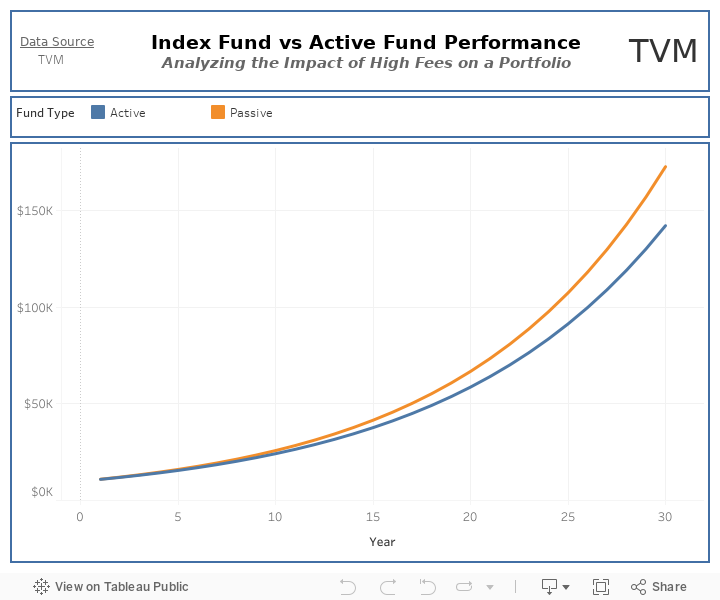
Due to its lower expense ratio, the passive index fund yielded an additional $30,484.33. Like returns, fees also compound over time. Some argue that actively managed funds can produce superior returns to compensate for the higher fee, and while it’s not impossible to outperform the market, consistent outperformance is rarely achieved.
The Instant and Automated Diversification Advantage of Index Funds
In real estate, they say “Location, Location, Location.” When it comes to investing and risk management, it’s all about “Diversification, Diversification, Diversification.” By their very nature, index funds offer instant diversification across a broad spectrum of assets. By tracking entire market indices, index funds inherently spread risk and exposure, diminishing vulnerability to the fluctuations of individual stocks.
Embracing the Beauty of Index Fund Investing
The Power of Consistent Diversification
Diversification not only cushions against market volatility but also provides a safeguard against the potential downfall of any single company.
Many investors have come to rely on the wisdom of diversifying their portfolios across various investment options. The concept of “don’t put all your eggs in one basket” rings true when it comes to mitigating the risks associated with market fluctuations. It’s akin to tending to a garden with a variety of flowers; if one wilts, the others continue to bloom, sustaining the overall allure of the garden.
The Self-Pruning Nature of Index Funds
By the same token, index funds are also considered self-pruning.
When an unsuspecting individual stock is either booted out or welcomed into a certain index, the index fund maintains synchronization without any need for human intervention. This autonomous pruning action embodies the hands-off approach that index funds stay true to, capturing the market’s natural movements without a sliver of human interference.
The Burden of Manual Portfolio Diversification
Contrast this with the individuals who are meticulously hand-picking individual securities in order to create a robust and diversified portfolio.
Though this approach may yield a comparable diversification effect, it comes with heightened frictional costs, be they in the form of time, money, or both. The manual curation of an optimal level of portfolio diversification demands substantial effort, making it akin to tending a meticulously-landscaped garden—requiring constant attention, care, and resources to maintain its splendor.
Embracing the Efficiency of Index Fund Investing
Amidst this, the unparalleled beauty lies in the convenience and efficiency that index fund investing offers.
With the recurring challenge of consistently outperforming the market, index funds present themselves as a beacon of respite. In a race where beating the market is incredibly difficult, the option to simply join and harness its potential offers a sense of relief and rationality. It’s akin to joining a marathon and realizing that running alongside the current record holders might be a more prudent choice than relentlessly attempting to outrun them.
Parting Words
It’s important to remember that market involvement is not a one-size-fits-all journey, and what works for some may not work for others. The notion of embracing the simplicity and efficiency of index funds should be weighed alongside individual financial goals, risk appetite, and personal circumstances.
Therefore, as you navigate the ever-evolving landscape of the financial markets, consider the wisdom in embracing the inherent efficiency and practicality offered by index funds, while also bearing in mind the necessity for a tailored approach to your investment decisions.
Disclaimer: Nothing in this article should ever be considered advice, research or an invitation to buy or sell securities. I am not a financial advisor.
The views and opinions expressed herein are the views and opinions of the author and do not necessarily reflect those of Nasdaq, Inc.
5 Stocks Our Experts Predict Could Double In the Next Year
By submitting your email, you'll also get a free pivot & flow membership. A free daily market overview. You can unsubscribe at any time.