Following the election of William Lai Ching-te as Taiwan’s President, representing the Democratic Progressive Party (DPP) and winning 40.2% of the votes in a three-way race, concerns have emerged regarding the potential impact on Taiwan Semiconductor Manufacturing Company (TSMC) stock. The election of a DPP leader signifies a more distinct Taiwanese identity apart from China, potentially heightening risks of escalation with Beijing.
While the heightened geopolitical tensions present risks for TSMC, a deeper analysis suggests that concerns may be overblown. Diversifying portfolios away from companies directly dependent on TSMC for growth and exploring uncorrelated industries, asset classes, and diverse country exposure may offer a prudent approach amid potential escalation in global geopolitics, hinged on US-China relations.
2024 Election Update
The vice president-elect of Taiwan, Hsiao Bi-khim, emphasized TSMC’s significance to the country during the election, describing it as “the pride of Taiwan” and “a sacred mountain protecting the country.” Additionally, Taiwan has been diversifying its external economic activities away from China, including investments and exports to the US and ASEAN. Controversies over TSMC’s US investments, such as the Arizona plant, could indicate growing anxieties surrounding Taiwan-US and US-China relations.
If heightened geopolitical tensions result from a stronger independence stance in Taiwan, trade relations may be affected, potentially impacting TSMC’s operations, especially as China is a large market for semiconductors. Changes in policy that affect the company’s operational freedoms may also influence investor sentiment. On the other hand, bolstered ties with the US in technology and trade could potentially drive an increase in TSMC stock price.
Current Financials
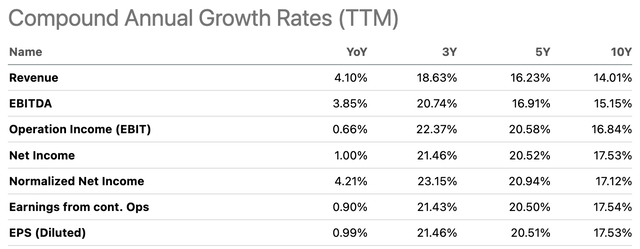
Despite strong profitability, with a Quant Factor Grade A+, TSMC’s growth is graded at a lower D+, with valuation rated a C. Charting TSMC’s net income margin over the long term reveals a moderate growth trajectory, approaching an already high figure of about 40%. The firm’s revenues have shown significant growth but experienced a moderate decline over the past year.
These financial shifts have been influenced by the global macroeconomic environment, featuring higher interest rates and inflation post-pandemic. The increased costs of borrowing and prices have impacted consumption habits, particularly in the technology sector dependent on advanced semiconductor chips.
Comparative Analysis
Comparing TSMC’s net margins to peers shows its dominant position in the industry, despite a stark rise in total liabilities in recent years in comparison to total equity. This surge is driven by the firm’s strategic expansion and technological advancements, often funded by debt, including the investment of $43.5 billion in the US with the Arizona plant.
Valuation Update
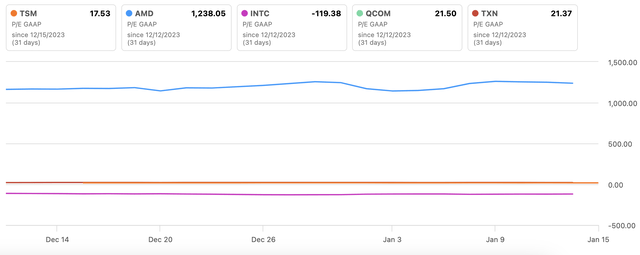
TSMC’s forward P/E ratio of around 20, combined with a Quant Factor Grade B+ and a forward PEG non-GAAP ratio of 2.75 (Quant Factor Grade C-), positions it favorably relative to its peers, indicating a relatively strong performance compared to rivals such as Intel (INTC) and Advanced Micro Devices (AMD).
Taiwan Semiconductor Manufacturing Company: A Diamond in the Rough
With the advent of advanced technology and the global economy, investors have constantly sought opportunities to identify undervalued stocks. One such company that seems to fit the bill is Taiwan Semiconductor Manufacturing Company (TSMC).
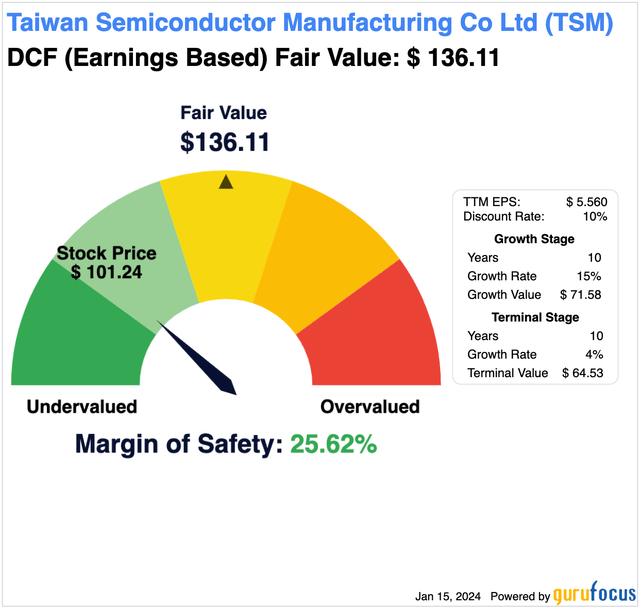
According to a discounted cash flow analysis, TSMC appears significantly undervalued at the moment. With an estimated fair value of $136.11 and potential for continued high growth, the stock represents a compelling investment opportunity in the current market.
Risks and Opportunities Amid Global Tensions
TSMC’s strategic investments in the United States and Germany are pivotal for its geographical diversification and overall growth trajectory. However, the geopolitical tensions between the US, China, and Taiwan introduce a layer of uncertainty and potential risks for the company. This conscious effort to diversify operations could be hindered by geopolitical constraints and trade sanctions, impacting shareholder value.
Moreover, the impact of geopolitical risk on investor sentiment cannot be underestimated. While the current global tensions may evoke concerns, it is essential to acknowledge the potential for diplomatic resolutions that could alleviate the apprehensions surrounding TSMC and other technology stocks.
Strategic Portfolio Management in Volatile Times
In light of the prevailing uncertainties, prudent investors may consider diversifying their portfolios to mitigate exposure to technology sectors and US stocks. The incorporation of uncorrelated asset classes, industries, and international markets can provide a balanced approach and potentially shield against medium-term volatility in the technology sector.
It is imperative to recognize the significance of protecting investments from uncertainty, laying the foundation for sustainable long-term growth and resilience in dynamic market conditions. As such, an analyst rating for TSMC at this juncture could be a cautious ‘Hold’ to navigate the current market landscape.