Addressing Cybersecurity Concerns
UnitedHealth Group, a leading figure in the healthcare industry, made a resilient proclamation recently to assuage the repercussions of cyberattacks on providers and consumers. The company stands steadfast, offering financial support to providers grappling with unmet medical cost reimbursements—a commendable effort in the wake of the debilitating cyberattack targeting its subsidiary, Change Healthcare. The reverberations of this assault have sent shockwaves through the healthcare sector, creating a challenging environment for industry players.
Software Solutions for Seamless Operations
UNH is diligently testing its innovative medical claims preparation software to equip customers with the necessary tools for future use. The launch of this software signifies a recommitment to delivering comprehensive services to its clientele. The recent travails in the healthcare industry have hindered hospitals’ ability to process insurance claims efficiently, provide essential care, and secure reimbursements. However, UnitedHealth has successfully met its target to unveil the medical claims processing software by March 18, a promising development for the company and its stakeholders.
Resilience and Recovery
Efforts are underway to restore Change Healthcare’s electronic payments platform and essential pharmacy network services, with 99% of the latter already operational since March 7, 2024. UnitedHealth’s proactive measures include disbursing over $2 billion in advancements to support care providers during these testing times. The company’s commitment to reestablishing full operational capacity shines through as it progresses through its phased recovery strategy.
Supporting Healthcare Providers Amidst Adversity
The ripple effects of the cyberattack have been particularly challenging for smaller healthcare service providers due to the industry’s fragmented nature. UnitedHealth remains dedicated to extending financial assistance to ease the operational burdens of providers grappling with reimbursement uncertainties. Noteworthy initiatives include the suspension of prior authorizations for a majority of outpatient services and utilization reviews for Medicare Advantage plans’ inpatient admissions.
Market Performance and Future Outlook
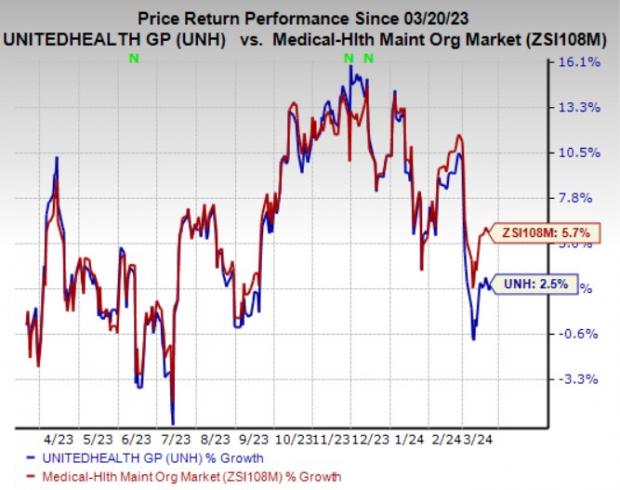
UnitedHealth Group has seen a 2.5% increase in its stock value over the past year, though slightly lagging behind the medical industry’s overall growth of 5.7%. With a current Zacks Rank #3 (Hold), the company continues to navigate through challenges while maintaining a positive outlook for the future.
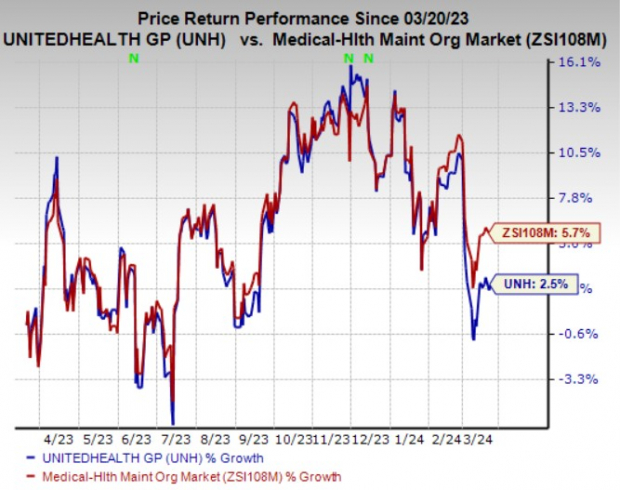
Image Source: Zacks Investment Research
Potential Investment Opportunities in the Healthcare Sector
For investors seeking promising prospects within the medical landscape, consider exploring stocks such as Organon & Co. (OGN), The Ensign Group, Inc. (ENSG), and The Cigna Group (CI). These companies exhibit strong potential, with Organon holding a Zacks Rank #1 (Strong Buy) while Ensign Group and Cigna boast a Zacks Rank #2 (Buy). Delve into the details of these offerings to uncover opportunities aligning with your investment goals.
Accurate Projections and Positive Outlook
Organon has demonstrated impressive performance, exceeding earnings expectations in two out of the last four quarters. Despite minor hiccups, the company maintains an average surprise factor of 5%. Envisage growth in OGN’s earnings and revenues, signaling positive momentum for the year ahead. As for Ensign Group and Cigna, both entities showcase strong performance metrics and are well-positioned for sustained growth moving forward.
Seizing Opportunities in the Market
The evolving healthcare sector presents a dynamic landscape with potential for lucrative investments. Stay informed and capitalize on market trends by seizing opportunities presented by companies demonstrating resilience and growth potential. Strategic investments aligned with industry trends can pave the way for substantial returns in the ever-evolving healthcare sector.
The views and opinions expressed herein are the views and opinions of the author and do not necessarily reflect those of Nasdaq, Inc.
5 Stocks Our Experts Predict Could Double In the Next Year
By submitting your email, you'll also get a free pivot & flow membership. A free daily market overview. You can unsubscribe at any time.