Exploring Put Options as an Alternative for Joby Aviation Investments
Investors interested in Joby Aviation Inc (Symbol: JOBY) may find the current market price of $6.58 per share unappealing. For those looking for alternative strategies, selling put options might be worth considering. One notable contract to examine is the January 2027 put at a $4 strike, with a current bid of 65 cents. Collecting this premium translates to a 16.2% return based on the $4 commitment, equating to a 9.6% annualized return.
It’s important to note that selling a put does not afford the investor the same upside potential as owning the stock. A put seller would only acquire shares if the contract is exercised, which occurs when the underlying stock price dips below $4. The buyer would only exercise the option if it proves more beneficial than selling at the current market price. If Joby shares were to fall by 39.1%, the put seller would see a cost basis of $3.35 per share, derived by subtracting the 65 cents premium from the $4 strike price. The only reward to the put seller lies in the premium collected, yielding a 9.6% annualized return unless the option is exercised.
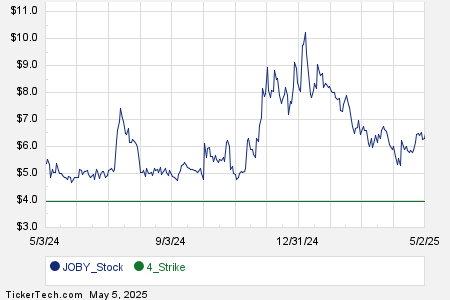
Below is a chart highlighting Joby Aviation’s trading history over the trailing twelve months, indicating where the $4 strike is positioned:

This chart, alongside the stock’s historical volatility, can help investors assess whether selling the January 2027 put at the $4 strike offers a reasonable reward relative to the risks involved. We’ve calculated the trailing twelve-month volatility for Joby Aviation Inc, based on the last 249 trading day closing values and the current price of $6.58, to be 79%. For additional put options with various expiration dates, consider visiting the JOBY Options page.
During mid-afternoon trading on Monday, the put volume among S&P 500 components reached 810,250 contracts, equal to the call volume for the same period. This results in a put:call ratio of 0.72, which is higher than the long-term median of 0.65. This indicates a higher level of put buying activity than expected based on historical averages.
Investors may consider analyzing which call and put options are attracting trader interest today.
The views and opinions expressed herein are the views and opinions of the author and do not necessarily reflect those of Nasdaq, Inc.