Three Key Strategies for Successful Options Trading
“Progress always involves risk. You can’t steal second base and keep your foot on first.” – Frederick B. Wilcox
Options trading presents both opportunities and risks. While options have inherent leverage and can be lucrative, they also carry greater risks than individual stocks and ETFs. Understanding these risks allows traders to better their chances of success.
Managing risk effectively while generating consistent profits is essential for successful trading. Many options traders fail because predicting market movements is challenging, leading to a high rate of expiration worthless. However, traders can adopt strategies to improve their odds.
Use an Online Discount Broker
In recent years, trading commissions have significantly decreased, particularly for options. Discount brokers are competing hard, which has led to lower trading rates. Most investors can now trade stocks for free, and options contracts cost mere pennies.
As investment methods increasingly rely on digital platforms, many prefer trading independently rather than paying advisors. This trend has driven costs nearly to insignificance.
While full-service brokers will still be needed, many traders should explore different discount broker options to find what suits them best.
Reduce Hidden Costs of Trading Options
Every trade involves a counterparty, such as a market maker. When buying a call option, the market maker is effectively selling it to you. Options are often less liquid than stocks, leading to a wider bid/ask spread, which can complicate trades.
One effective way to address this issue is to utilize limit orders. A limit order specifies the highest price a trader will pay or the lowest price they will accept.
For instance, consider AMZN’s July 18 160-strike call, bid at 44.3 and ask at 44.9. The total ask price for this contract is $4,490, while sellers might take $4,430. If a market order executes at the ask price, limit orders can potentially yield substantial savings by filling at a midpoint price, reducing the cost to $4,460. This approach becomes more beneficial with less liquid stocks.
Quantify Risk/Reward of Every Trade
Amazon is showing signs of a long-term uptrend, making it a viable option for call purchases. A correctly executed options trade can offer significant profits with limited risk.
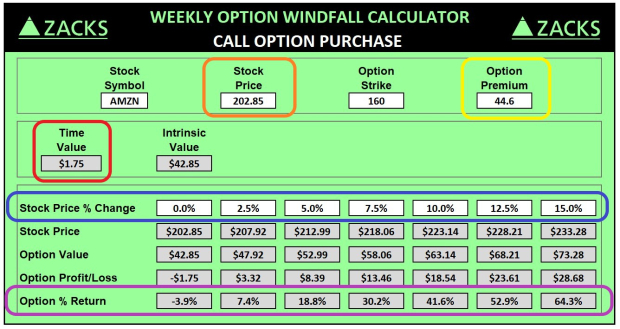
Focusing on the AMZN July 18 160-strike call, which allows the purchase of 100 shares at $160, represents a total cost of $4,460. Changes in AMZN’s stock price directly influence the potential returns on this trade.
The table below illustrates various scenarios based on AMZN’s performance by the expiration date. Maintaining the stock price could result in a minor loss of 3.9%. A 5% increase would yield an 18.8% profit, while a 15% rise could lead to a 64.3% profit.
This illustrates the leverage options provide. Investing $20,285 in 100 shares of Amazon would yield a $3,042 profit with a 15% price increase. In contrast, an option trader would only need to invest $4,460, still achieving nearly identical profits with a smaller investment.
Additionally, the option’s time value is minimal, equating to just 0.9% of the stock price. It’s wise to minimize time value when purchasing options since it tends to decline rapidly as expiration approaches.
By managing risk and utilizing these strategies to lower trading costs, traders can improve their prospects for favorable outcomes in options trading.
Disclosure
The Zacks Headline Trader portfolio has a position in Amazon.