“`html
Wall Street Sees Historic Volatility and Key Market Indicators
For much of the past two and a half years, Wall Street has been in a bull market. Enthusiasm for the rise of artificial intelligence, excitement over stock splits among leading companies, and the resilience of the U.S. economy have driven the Dow Jones Industrial Average (DJINDICES: ^DJI), the broad-based S&P 500 (SNPINDEX: ^GSPC), and the growth-oriented Nasdaq Composite (NASDAQINDEX: ^IXIC) to record highs. However, equity markets inherently fluctuate, reflecting both upward and downward movements.
The past eight weeks have presented a turbulent period for the Dow, S&P 500, and Nasdaq Composite. Throughout this time, these indexes experienced their largest single-session point gains and declines since their inception, marking significant volatility.
When examining the overall picture, it’s clear that the Dow Jones and S&P 500 have fallen into correction territory, while the Nasdaq Composite has entered bear market conditions.

Image source: Getty Images.
In times of increased volatility, investors often seek out data events that may correlate with stock market trends. While no single data point guarantees short-term movements, history suggests that some indicators have been strong predictors of shifts in the S&P 500.
Tariff Concerns and Market Valuation Lead to Uncertainty
Before exploring a recent rare market occurrence, it’s important to understand the factors contributing to current volatility in Wall Street’s landscape.
Typically, fear and uncertainty drive fluctuations in equities. Recently, much of the instability has stemmed from former President Donald Trump’s tariff policy and the high valuations of stocks in the current market.
On April 2, deemed “Liberation Day” by the president, Trump unveiled a sweeping tariff policy comprising a global tariff of 10% and higher reciprocal tariffs on specific countries with significant trade imbalances with the U.S. As of April 9, except for tariffs on China, these reciprocal tariffs are on a 90-day pause.
While the goal of these tariffs is to increase revenue, protect U.S. jobs, and promote domestic manufacturing, several potential issues arise from this approach.
One concern is the possibility of triggering a trade war with China, the world’s second-largest economy, and potentially straining relations with U.S. allies. Additionally, Trump’s policy does not differentiate between output and input tariffs; output tariffs affect finished goods while input tariffs are taxes on materials used domestically, putting American businesses at a pricing disadvantage.

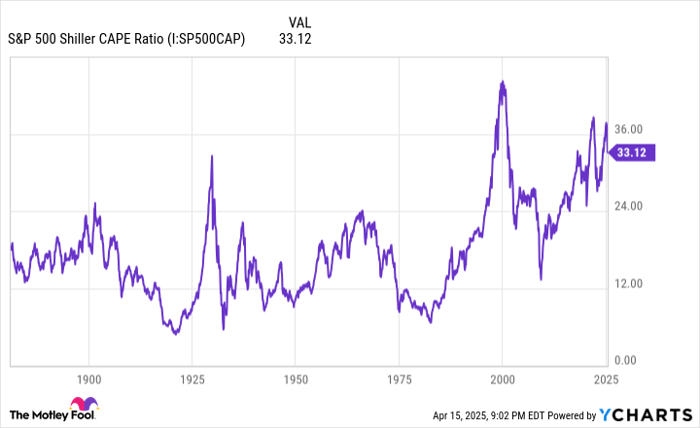
S&P 500 Shiller CAPE Ratio data by YCharts.
Additionally, entering 2025, the stock market is among the priciest in history. The S&P 500’s Shiller price-to-earnings (P/E) Ratio, also referred to as the cyclically adjusted P/E Ratio (CAPE Ratio), indicates that Donald Trump inherited one of the highest valuation markets of any incoming president.
In December, the S&P 500’s Shiller P/E reached nearly 39 during the current bull market cycle. Excluding its all-time high of 44.19 in December 1999 and the January 2022 peak of around 40, this metric, upon 154 years of back-testing, has never shown higher figures.
Despite the recent correction that has lowered the Shiller P/E to 33.38 as of April 15, this still stands nearly double its historical average of 17.23.
Looking back, in the previous five occurrences when the Shiller P/E surpassed 30 for two months, the Dow Jones, S&P 500, and/or Nasdaq Composite suffered declines of 20% or more, suggesting an unsustainable market premium.

Image source: Getty Images.
A Rare Event Signals Potential Optimism
Now that the background on Wall Street’s volatility is established, let’s examine the rare event that just transpired, often seen as a positive sign for long-term investors.
On April 9, coinciding with Trump’s announcement of a 90-day pause on most reciprocal tariffs, the Dow Jones Industrial Average, S&P 500, and Nasdaq Composite recorded the largest one-day nominal point gains in their history. Specifically, the Dow surged by 2,963 points (its 19th-largest percent increase), the S&P 500 soared by 474 points (tied for the eighth-biggest percent jump), and the Nasdaq Composite increased by 1,857 points (its second-largest percentage gain since inception).
Historically, significant single-session gains have often preceded positive trends in stock performance following a short digestion period for investors.
On social media platform X, Ryan Detrick from Carson Group remarked that April 9 was a noteworthy day for optimism on Wall Street. This day marked just the seventh instance in the last 45 years where the New York Stock Exchange’s advancing volume (the share volume tied to stocks that rose) achieved notable levels in relation to total NYSE volume.
“`
Record NYSE Advancing Volume Signals Potential Market Gains Ahead
On April 9, an extraordinary 98.6% of volume on the NYSE consisted of advancing stocks, marking the highest percentage on record since 1980.
Last Wednesday saw 98.6% of all the volume on the NYSE advance. That was the highest ever (using data since 1980). Dates like Aug ’82 and March ’09 are in there and strong future returns are quite impressive. pic.twitter.com/0sxi4REAqf
— Ryan Detrick, CMT (@RyanDetrick) April 14, 2025
Historical Performance Insights
Future returns for the S&P 500 following such substantial up days exhibit mixed results over the short term. However, historical data indicates that the bulls tend to prevail when analyzing a 12-month period after these remarkable volume increases. In the past, every instance since 1980 in which the NYSE recorded at least 97% advancing volume led to double-digit percentage gains in the S&P 500 over the following year.
Further emphasizing this trend, the stock market’s performance after similar up days has exceeded expectations. The average gain over 12 months was 29.2%, substantially higher than the average annual return of 9.2% since 1950. This trend suggests that significant advancing volume on the NYSE has historically served as a precursor for strong stock performance.
Considerations for Future Predictions
It is essential to remember that while there is a compelling correlation between these historical up days and future S&P 500 returns, it does not guarantee increased index values a year from now. The Shiller P/E ratio currently indicates premium valuation levels, and historical data reveals that the market has never reached a bottom with a Shiller P/E above 30.
Nevertheless, the inherent nonlinearity of stock market cycles suggests that patience can reward long-term investors. As economic growth continues, driven by robust business dynamics, the Dow, S&P 500, and Nasdaq are poised to reach new highs, even amid tariff disputes and valuation-related uncertainties.
Is Now the Right Time to Invest in the S&P 500?
Before committing to the S&P 500, consider this:
The Motley Fool Stock Advisor analyst team recently listed what they deem the 10 best stocks to buy now, excluding the S&P 500 Index. These selected stocks have the potential for substantial returns in the years ahead.
For example, Netflix was highlighted on December 17, 2004, and an investment of $1,000 at that time would be worth $526,499* today. Likewise, Nvidia featured on April 15, 2005, and a similar investment would translate to $687,684*.
Notably, the total average return for Stock Advisor stands at 818%—significantly outperforming the S&P 500’s 156%. Don’t miss the latest top 10 list available with your Stock Advisor membership.
See the 10 stocks »
*Stock Advisor returns as of April 14, 2025
Sean Williams has no position in any of the stocks mentioned. The Motley Fool has no position in any of the stocks mentioned. The Motley Fool has a disclosure policy.
The views and opinions expressed herein are the author’s and do not necessarily reflect those of Nasdaq, Inc.