US Stocks Remain Resilient Amid Moody’s Credit Downgrade
Market Reaction Following Moody’s Downgrade
In the world of finance, just as in poker, a “tell” can indicate what lies ahead. On Wall Street, the most telling sign is how the market responds to negative news. Following a downgraded US credit rating by Moody’s (MCO), based on the growing US budget deficit, the Nasdaq and other major indices fell over 1% after the market closed on Friday. However, by Monday, stocks rebounded, illustrating the strength of the current bull market. Wise investors might ponder, “If bad news can’t hurt stocks, what happens in the absence of news?”
Comparison of Current Trends with the Late 1990s
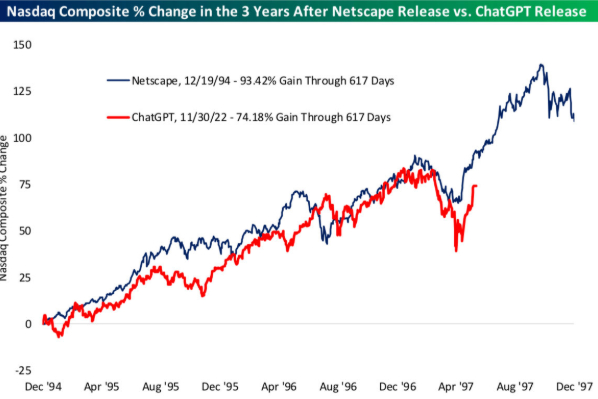
A recent chart by BeSpoke Investment Group (@bespokeinvest) compares the launches of Netscape and ChatGPT. This trend, tracked by the tech-heavy Nasdaq, mirrors past patterns. The Netscape web browser launched during the late 1990s spurred the internet boom, while ChatGPT has initiated the AI revolution.
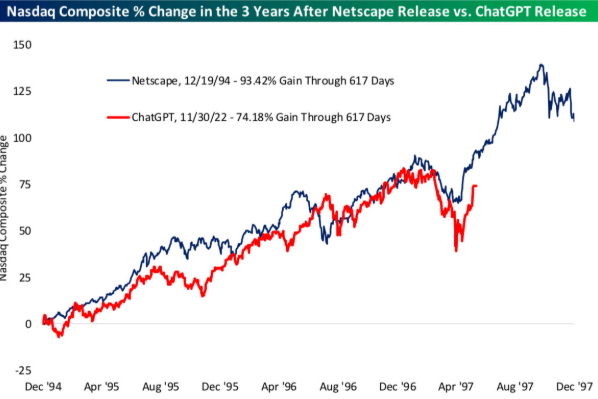
Image Source: BeSpoke Investment Group
This overlayed chart reveals that the Nasdaq has risen 74.18% over 617 days, closely following the late 1990s precedent of 93.42% during the same timeframe. Moreover, companies driving the AI sector, such as Broadcom (AVGO), Microsoft (MSFT), and CoreWeave (CRWV), indicate that this growth phase may just be beginning.
S&P 500 Index Surges, Future Growth Expected
Similar to baseball’s steroid era, where power hitters like Barry Bonds shattered records, stock performance often correlates with the market’s strength. Following a warming in trade tensions with China, the S&P 500 Index surged over 19% in just 27 days. Historical numbers suggest that when the S&P 500 gains more than 19% in a short period, it tends to keep rising. Research by Ryan Detrick (@ryandetrick) indicates that since 1950, the S&P 500 has risen 100% of the time one year later after such gains.

Image Source: Carson Investment Research
Conclusion
On Wall Street, recognizing subtle cues is vital. The market’s robust response to Moody’s downgrade and the historical patterns from the late 1990s both suggest an optimistic outlook ahead.