Bitcoin’s Volatility Post-All-Time High
The cryptocurrency arena has once again demonstrated its unpredictable nature, with Bitcoin reaching an all-time high of $73,835.57 last week, only to plummet 14% to $63,256 in just a matter of days. The question on everyone’s mind: Is this a golden opportunity to buy the dip, or a harbinger of a more significant crash on the horizon?
Amidst macroeconomic fluctuations and inflation concerns, Luke Lango, a prominent figure in the crypto community, suggests that while the market may be facing short-term headwinds, the long-term trajectory remains promising for cryptocurrencies. Inflation, though currently stabilizing at ‘normal’ levels, is expected to pave the way for renewed investor confidence and a subsequent surge in crypto investments.
Lango advises caution, indicating that the technical analysis for Bitcoin (BTC-USD) points towards further downturns before a suitable entry point is reached. The message is clear: patience is key.
Unpacking the Historical Context: Bitcoin’s Halving Effect
As the Bitcoin halving event looms on the horizon, it’s worth delving into its historical impact on the cryptocurrency market. With each halving reducing the reward for miners by half, the anticipation typically triggers a surge in Bitcoin’s price in the lead-up to the event. However, post-halving corrections are not uncommon, with previous instances showing declines of up to 38% in 2016 and 20% in 2020.
Experts suggest a potential 20% correction for the upcoming event in 2024, emphasizing the cyclical nature of Bitcoin’s price movements. The period following the halving often involves a phase of re-accumulation, leading to accelerated growth and new all-time highs in the subsequent months.
Looking Ahead: Post-Halving Projections and Market Trends
Despite the current uncertainties, projections for Bitcoin’s future value continue to soar. Standard Chartered, a global banking giant, has raised its 2024 price target for Bitcoin to $150,000, with further rallies expected in 2025 culminating in prices around $200,000. These optimistic forecasts align with the increasing adoption of Bitcoin and other cryptocurrencies on a global scale.
With major players like Coinbase and MicroStrategy doubling down on Bitcoin investments and institutional investors flocking to crypto assets, the financial landscape is evolving rapidly. Initiatives such as the London Stock Exchange’s acceptance of Bitcoin and Ether ETNs and the development of blockchain payment systems by various nations underscore the growing legitimacy of cryptocurrencies in traditional finance.
Indicators of Growing Demand: Bitcoin’s Ascendancy
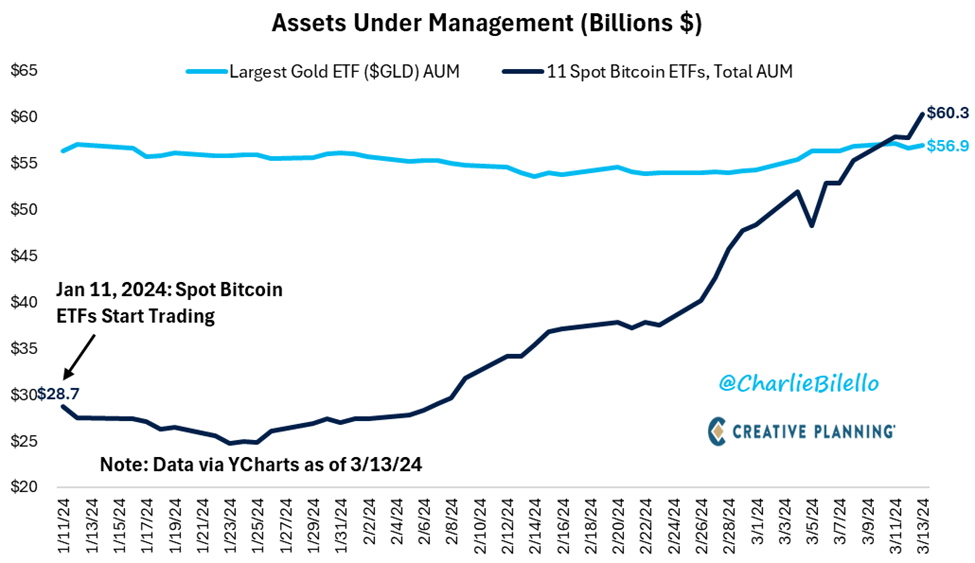
Analysts tracking Bitcoin ETFs reveal a remarkable surge in assets, with total holdings exceeding $60 billion across 11 spot Bitcoin ETFs. This milestone, achieved in record time, highlights the surging demand for Bitcoin investments compared to traditional assets like gold. Notably, the speed at which Bitcoin ETFs amassed assets eclipses even the most established ETFs, signaling a seismic shift in investor preferences towards digital assets.
The Ongoing Battle: Crypto Under Fire from Reintroduced Digital Asset Mining Energy Tax
Amidst the roaring success of Bitcoin and crypto assets this year, a dark cloud looms over the sector. The U.S. government, spearheaded by President Joe Biden, has reignited its pursuit to regulate and tax the flourishing crypto industry.
Government Interference Sparks Concerns
In a challenging turn of events, the Biden administration has resurrected a controversial proposal aimed at taxing bitcoin and crypto miners who utilize energy-intensive computers for network security and transaction validation.
Citing a need for regulation, the U.S. Treasury Department outlined plans for a 30% excise tax on the electricity costs associated with digital asset mining activities. This move has drawn strong criticism, with industry experts warning of catastrophic consequences if the tax is implemented.
Industry Backlash and Foreseen Ramifications
The notion of a blanket 30% federal tax on digital mining has elicited swift backlash from key figures within the crypto sector. Taras Kulyk, the CEO of mining hardware company SunnySide Digital, unequivocally warned that such a tax could trigger an exodus of miners from the U.S., akin to the mass migration witnessed in China following its crackdown on miners in 2021.
The proposed Digital Asset Mining Energy Tax (Dame) hits a raw nerve in the industry, with fears rife that its enforcement could spell disaster for both miners and investors. There are genuine concerns that this move could decimate the sector and erase billions worth of investor value in a flash.
Implications for Investors
For crypto investors, the specter of the digital tax looms large, casting a shadow of uncertainty over the market. A potential implementation of such a tax could trigger seismic shifts within the crypto landscape, impacting portfolios and industry dynamics alike.
It is imperative for stakeholders to closely monitor the developments unfolding in the regulatory sphere. The outcome of this regulatory bout will undoubtedly leave a lasting imprint on the future trajectory of the crypto market.
Looking Ahead
As the crypto community braces for a period of intense scrutiny and regulatory turbulence, the hope lingers that policymakers will proceed cautiously. A delay in the implementation of the digital tax could offer a much-needed respite, providing the market with space to navigate challenges and potentially thrive in the aftermath.
In the midst of regulatory uncertainties, vigilance remains key for investors seeking to weather the storm and capitalize on opportunities in the ever-evolving crypto landscape.
Wishing you a restful evening,
Jeff Remsburg
5 Stocks Our Experts Predict Could Double In the Next Year
By submitting your email, you'll also get a free pivot & flow membership. A free daily market overview. You can unsubscribe at any time.