Nvidia Faces Challenges as AI Boom Peaks: Key Factors to Watch
About thirty years ago, the rise of the internet began transforming business practices globally. While this change did not happen instantly, investors have eagerly awaited another significant innovation to enhance corporate America’s growth potential. It seems that artificial intelligence (AI) may finally provide that spark.
AI is enabling software and systems to make decisions and learn independently of human input. With applications spanning many industries, analysts at PwC predict that AI could add a staggering $15.7 trillion to the global economy by 2030.
Start Your Mornings Smarter! Get Breakfast news delivered to your inbox every market day. Sign Up For Free »
Currently, no company is more prominent in the AI hardware market than Nvidia (NASDAQ: NVDA). Its Hopper (H100) and Blackwell graphics processing units (GPUs) have quickly become essential for enterprise data centers, which need to train large language models and support generative AI applications.
However, concerns are arising about Nvidia’s prospects. After the company’s fiscal 2025 fourth-quarter results are released on February 26, there are three main reasons why Nvidia might not meet investor expectations.

Image source: Getty Images.
Declining AI-GPU Scarcity
While Nvidia’s Blackwell chip remains unmatched in speed by any competitor, the company has also relied heavily on a shortage of AI-compatible GPUs. The strong demand and limited supply enabled Nvidia to secure long-term orders and charge premium prices. In early 2024, Advanced Micro Devices was selling its Instinct MI300X chips for around $10,000 to $15,000, while Nvidia’s Hopper chips were priced at up to $40,000. This led to a peak gross margin of 78.4% in Q1 of fiscal 2025.
Investors should be cautious as the shortage of AI-GPUs is expected to diminish, thus squeezing Nvidia’s pricing power and profit margins. Although competitors like AMD have drawn attention, the more significant risk comes from major clients developing their own AI chips. While these alternatives may not match Nvidia’s performance, they are cheaper and readily available, which could hinder future sales of Nvidia’s hardware.
Notably, Nvidia’s gross margin has already retraced by 380 basis points since its peak, and further competition could put additional pressure on profitability.
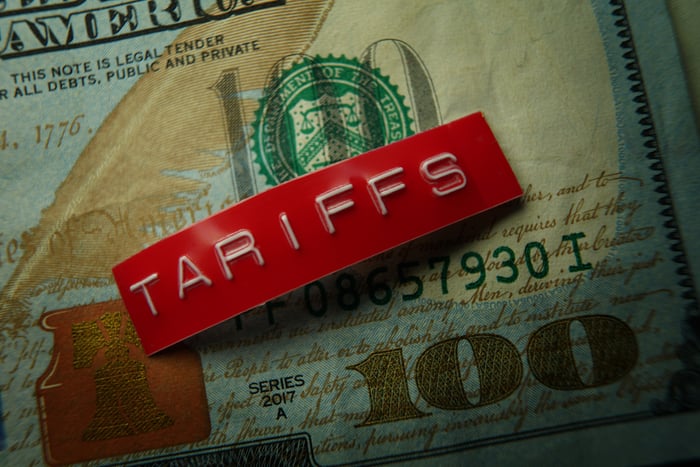
Image source: Getty Images.
Impact of Tariffs and Trade Restrictions
Wall Street tends to favor predictability, and uncertainties surrounding tariffs and trade restrictions may cloud Nvidia’s outlook. During the 2016 presidential campaign, then-candidate Donald Trump indicated a willingness to impose tariffs to support U.S. industries. Recently, he introduced a 10% tariff on select imports from China.
A December analysis from Liberty Street Economics revealed that companies affected by tariffs saw their stock prices decline significantly when the tariffs were announced. These businesses struggled with profits and productivity from 2019 to 2021.
Although Nvidia does not import from China, the country is a major client for its hardware. Tensions between the U.S. and China could threaten billions in quarterly revenues for Nvidia. Additionally, the Biden administration has also restricted sales of Nvidia’s advanced AI chips to China for three consecutive years. Despite their differences, both Trump and Biden seem aligned on the need to protect U.S. AI interests, leaving little hope for increased exports in the near future.
Such limitations may result in conservative guidance from Nvidia’s management team as the release approaches.
Historical Patterns Suggest Caution
The final concern for Nvidia is the historical trend of technological innovations experiencing bubbles. Over the past three decades, every major advancement, including the internet, has encountered a bubble-bursting event. Investors often overestimate the timeliness of new technologies, leading to inflated expectations.
While AI presents numerous potential applications, many companies still struggle to implement it effectively to boost profits. If an AI bubble were to burst, Nvidia could benefit from established business units in gaming and cryptocurrency, cushioning its stock against severe declines.
However, Nvidia will also contend with a high valuation. In mid-2024, its stock reached a price-to-sales (P/S) ratio above 40, a level that has historically signaled top performance for other leading companies in new tech. Though the ratio has eased since then, Nvidia’s stock remains expensive, especially given the array of challenges it faces.
While analysts predict Nvidia’s stock will perform well in 2025, concerns about underperformance linger.
Should You Invest $1,000 in Nvidia Now?
Before purchasing Nvidia shares, consider this:
The Motley Fool Stock Advisor analysts have recently identified what they believe are the 10 best stocks for investors, and Nvidia is not among them. The selected stocks are expected to yield significant returns in the future.
Think back to when Nvidia was recommended on April 15, 2005… if you had invested $1,000 then, you would now have $795,728!
Stock Advisor provides investors with a straightforward roadmap for success, including portfolio advice, regular updates, and two new stock picks each month. Since 2002, the Stock Advisor service has more than quadrupled the returns of the S&P 500.
Learn more »
*Stock Advisor returns as of February 7, 2025
Sean Williams has no position in any of the stocks mentioned. The Motley Fool has positions in and recommends Advanced Micro Devices and Nvidia. The Motley Fool has a disclosure policy.
The views and opinions expressed herein are the views and opinions of the author and do not necessarily reflect those of Nasdaq, Inc.