Clients seeking robust income streams often turn to Master Limited Partnerships (MLPs) and energy infrastructure investments. These assets can serve various purposes in an investment portfolio, but they are most renowned for their ability to provide ample income.
Despite not being designed as fixed income substitutes, MLPs and energy infrastructure companies can significantly enhance yield in an income sleeve. Their income potential tends to outshine that of other equity income investments and bonds.
The Allure of Income Generation
Recent surveys from VettaFi indicate that advisors primarily lean on MLPs and energy infrastructure investments for their income-generating capabilities. Over 40% of respondents highlighted income as the primary use for MLPs in their portfolios, as per the 2024 Midstream/MLP Outlook published on January 10, 2024.
Furthermore, the stable nature of midstream yields renders them less sensitive to Federal Reserve actions and interest rate fluctuations. This resilience sets them apart from many other income-generating investments, bolstering their appeal in the current economic landscape. Notably, funds like the Alerian MLP ETF (AMLP) and the Alerian Energy Infrastructure ETF (ENFR) have the potential to deliver generous income regardless of interest rate dynamics.
As of February 27, the underlying index for AMLP boasted a substantial yield of 7.2%, while the index for ENFR offered a notable yield of 6.3%.
Potential for Strong Total Returns
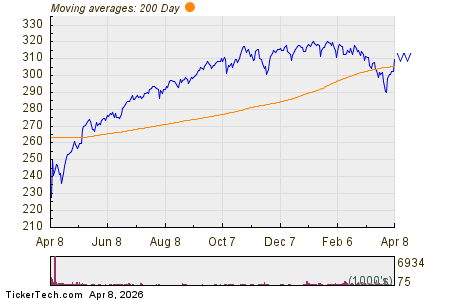
The underlying index for AMLP recently achieved a five-year price return peak, reaching levels not witnessed since February 2019. Simultaneously, the fund hit a four-year high in assets under management. AMLP, a popular MLP ETF, surpassed $8 billion in assets last week, marking the first time it has surpassed this milestone since January 2020.
For those intrigued by more industry news, detailed analysis, and insights, a visit to the Energy Infrastructure Channel could be enriching.
It’s essential to note that the opinions and expressions in this piece are solely those of the author and may not align with the views of Nasdaq, Inc.