F5 Inc. Anticipates Strong Earnings Growth in Q2 Fiscal 2025
F5 Inc. (FFIV) is expected to exceed earnings expectations when it discloses its second-quarter fiscal 2025 results on April 28, after the market closes.
Projected Earnings and Revenue Details
For the second quarter of fiscal 2025, F5 forecasts non-GAAP earnings per share (EPS) between $3.02 and $3.14, with a midpoint of $3.08. The Zacks Consensus Estimate stands at $3.10, reflecting a year-over-year increase of 6.5%. This estimate has not changed in the past 60 days.
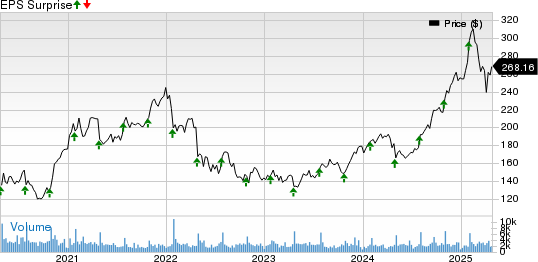
F5 has consistently outperformed the Zacks Consensus Estimate in the previous four quarters, achieving an average earnings surprise of 8.6%.
Additionally, F5 anticipates its second-quarter fiscal 2025 non-GAAP revenues will fall between $705 million and $725 million. The Zacks Consensus Estimate for revenue is currently $716.9 million, indicating a year-over-year growth rate of 5.2%.
F5, Inc. Price and EPS Surprise

F5, Inc. price and EPS surprise chart.
Key Factors Influencing Q2 Results
FFIV’s performance in the Product segment during the second fiscal quarter likely benefited from demand recovery for its software solutions. However, this growth may be tempered by ongoing IT budget constraints amid uncertain macroeconomic conditions. The increase in Software revenues has been a consistent trend over recent quarters, which is expected to continue. We estimate Software revenues at $173.1 million.
Sales in the Systems segment may also have experienced a boost due to customer technology refresh initiatives aimed at modernizing outdated hardware. Our estimate for Systems revenues is $151.2 million.
Overall, strong sales across both the Software and Systems sectors are projected to enhance the Product division’s performance, with an estimated total revenue of $324.3 million, reflecting an 8% year-over-year increase.
The growing adoption of BIG-IP and NGINX subscription software is expected to remain a major growth contributor. Notably, BIG-IP’s performance, automation capabilities, and cost advantages likely secured several new contracts in this quarter. Demand for NGINX subscriptions is anticipated to be robust, driven by large enterprises migrating their workloads to cloud and Kubernetes environments.
Moreover, F5’s cost-reduction measures, including workforce downsizing and consolidating its physical locations, are likely to positively impact its bottom-line performance.
Q2 Earnings Whispers for F5
Our analysis suggests a potential earnings beat for F5 this quarter. A positive earnings ESP combined with a Zacks Rank of #1 (Strong Buy), #2 (Buy), or #3 (Hold) enhances the likelihood of a favorable earnings outcome, which applies in this case.
FFIV’s earnings ESP: The earnings ESP, calculated as the difference between the Most Accurate Estimate ($3.12 per share) and the Zacks Consensus Estimate ($3.10 per share), is +0.69%.
FFIV’s Zacks Rank: Currently, FFIV holds a Zacks Rank #3.
Other Stocks with Favorable Earnings Outlook
Our model identifies other companies such as Qorvo (QRVO), Fortinet (FTNT), and Advanced Micro Devices (AMD) that also possess the favorable conditions for an earnings beat.
Qorvo is preparing to release its fourth-quarter fiscal 2025 results on April 29, with a Zacks Consensus Estimate of $1.01 per share. This estimate was revised upward by one cent over the last month but reflects a year-over-year decline of 27.3%. Qorvo shares have decreased by 45.6% in the past year.
Fortinet’s first-quarter 2025 results will be announced on May 7, where it holds an earnings ESP of +3.77% and a Zacks Rank #3. The Consensus Estimate for Fortinet’s EPS is 53 cents, marking a year-over-year growth of 23.3% due to a recent upward revision.
Advanced Micro Devices plans to report its first-quarter 2025 results on May 6, with an earnings ESP of +1.09% and a Zacks Rank #3. The Zacks Consensus Estimate for AMD’s EPS remains at 93 cents per share, indicating a significant year-over-year increase of 50% from the prior year.
Disclaimer
The views and opinions expressed herein are the views and opinions of the author and do not necessarily reflect those of Nasdaq, Inc.