Nvidia vs. AMD: Who Will Dominate the AI Chip Market?
Nvidia‘s (NASDAQ: NVDA) stock skyrocketed 2,750% over the last five years, driven by the booming artificial intelligence (AI) sector. Historically, Nvidia focused on gaming GPUs for PCs, but the emergence of generative AI led to a significant shift toward its high-end data center GPUs, which excel in handling complex AI tasks compared to traditional CPUs.
Nvidia’s early position allowed investors to capitalize on the rapid growth of the AI market. Yet, some may question whether Nvidia can sustain this momentum. Is AMD (NASDAQ: AMD), which saw a more modest 380% gain over the same period, a smarter investment in AI’s expansive future?

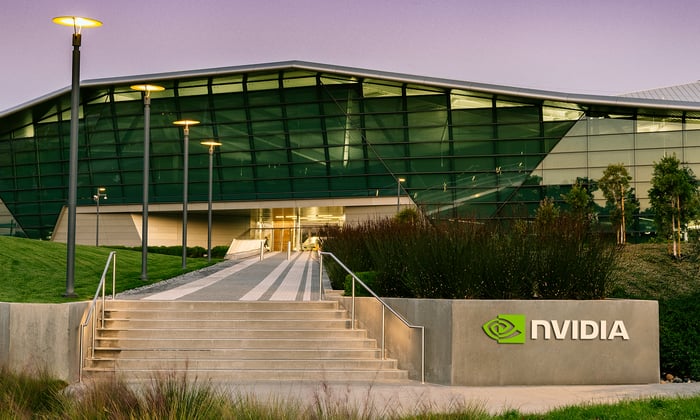
Image source: Getty Images.
Comparing the Business Models of Nvidia and AMD
Both Nvidia and AMD are fabless chipmakers that outsource manufacturing to companies like Taiwan Semiconductor Manufacturing Company, but their business models differ. Nvidia mainly earns revenue from discrete GPUs and reported that a staggering 87% of its earnings for the most recent quarter came from the data center market. The remainder of its income is derived from gaming, professional visualization, automotive, and OEM sectors.
On the other hand, AMD sells x86 CPUs for PCs and servers, discrete GPUs, and APUs, which combine CPU and GPU functions. Additionally, AMD acquired Xilinx in 2022, which produces programmable chips. In the latest quarter, AMD earned 48% of its total revenue from its data center segment, which markets its Instinct GPUs and Epyc CPUs.
Nvidia dominated the discrete GPU market with an impressive 88% share earlier this year, based on data from JPR, while AMD secured the remaining 12%. Moreover, TechInsights recently estimated that Nvidia commanded an astounding 98% of the data center GPU market last year.
In the x86 CPU sector, AMD faces stiffer competition from Intel. According to PassMark Software, AMD holds 36% of this market, with Intel at 61%. Over the past eight years, however, AMD has gained traction as Intel struggled with chip shortages and production delays.
Assessing Growth Rates of Nvidia and AMD
Historically, Nvidia and AMD heavily relied on the volatile PC market. Recently, Nvidia’s data center business experienced rapid growth, reducing its dependency on the PC market, which has faced slowdowns in the last two years following pandemic-induced spikes in demand. Conversely, AMD continues to depend significantly on the PC market, facing greater challenges as a result.
Analysts predict Nvidia’s revenue and earnings per share (EPS) will grow at a compound annual growth rate (CAGR) of 51% and 56%, respectively, from fiscal 2024 to fiscal 2027, as demand for its data center chips continues to exceed supply. Even though Nvidia’s chips are more expensive than AMD’s, their focus on power efficiency makes them appealing to data center operators dealing with substantial energy consumption.
For AMD, from 2023 to 2026, analysts forecast a revenue CAGR of 20%, fueled by the stabilization of the PC market and growth in its data center CPU and GPU sectors. The company’s EPS is expected to soar at a CAGR of 102% due to a shift towards higher-margin products. Economies of scale should also benefit AMD’s data center business as they bundle Epyc CPUs, Instinct GPUs, and Xilinx’s programmable chips together.
Evaluating Investment Value in Nvidia and AMD
At present, neither Nvidia nor AMD can be labeled a bargain. Nvidia trades at 38 times next year’s earnings, while AMD has a higher valuation at 44 times its estimated earnings. Despite the higher number for AMD, Nvidia appears more reasonably valued considering its growth potential in the long run. It seems poised to remain the go-to supplier for AI infrastructure for the foreseeable future, thanks to its straightforward business model. In contrast, AMD’s status as an underdog in both the GPU and CPU markets, along with its vulnerability to fluctuations in the PC market, may hinder its AI-related progress.
Overall, Nvidia and AMD represent better investment choices in the semiconductor sector compared to Intel. Yet, Nvidia is likely the more compelling option for those looking to invest in the expanding AI market. With its quicker growth rate and sharp focus on the data center segment, Nvidia stands out as the top choice for companies focused on upgrading to support the latest AI applications.
Seize Your Second Chance at Investment Gains
Are you feeling like you missed out on some of the most successful stocks? If so, you’ll want to pay attention now.
Our team of analysts occasionally issues a “Double Down” stock recommendation for companies posited for substantial growth. If you’re worried about missing another opportunity, the time to act is now. The statistics do speak for themselves:
- Amazon: If you invested $1,000 when we issued a double-down alert in 2010, you’d have $21,154!
- Apple: If you had invested $1,000 when we doubled down in 2008, you’d have $43,777!
- Netflix: Investing $1,000 when we alerted in 2004 would have turned into $406,992!
Currently, we’re providing “Double Down” recommendations for three incredible companies, and this opportunity may not present itself again anytime soon.
See 3 “Double Down” stocks »
*Stock Advisor returns as of October 28, 2024
Leo Sun has no position in any of the stocks mentioned. The Motley Fool has positions in and recommends Advanced Micro Devices, Nvidia, and Taiwan Semiconductor Manufacturing Company. The Motley Fool recommends Intel and has recommended the following options: short November 2024 $24 calls on Intel. The Motley Fool has a disclosure policy.
The views and opinions expressed herein are those of the author and do not necessarily reflect the views of Nasdaq, Inc.