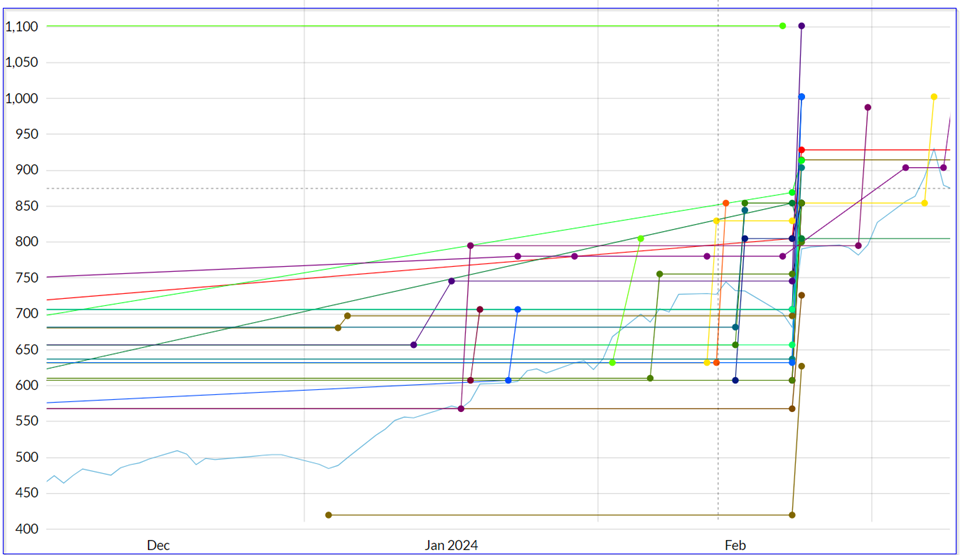
Nvidia Corp. (NVDA) could potentially see a 26% increase in value, reaching $1,141 per share. This projection is underpinned by the company’s robust free cash flow (FCF) margins. For current shareholders, there is an opportunity to generate additional income through shorting out-of-the-money (OTM) put options with near expiry dates, aligning with the trajectory towards the $1,141 target price.
Discussions surrounding this favorable outlook have been featured in recent Barchart articles, with a notable example released on Feb 25 titled, “Nvidia Stock Could Be Worth 42% More at $1,120 – Put Short Sellers Find This Attractive.”
During the initial analysis, NVDA stock resided at $786.90, prompting considerations for shorting $750 and $740 put options expiring on March 15. The generated premiums of $16.30 and $14.30 respectively offered 3-week yields of 2.173% and 1.932%. As the stock closed at $878.37, these puts expired without exercise, resulting in profitable outcomes for the short-sellers who avoided the exercise necessity to purchase the stock. Existing shareholders who engaged in this strategy reaped the full benefits of NVDA’s upward movement.
Forecasted Growth Based on Nvidia’s FCF
As of March 28, NVDA stock has surged to $903.56, accompanied by elevated put option premiums. This heightened scenario opens doors to significant expected returns (ER) and advantageous short-put yield prospects, especially beneficial for long-term investors in NVDA.
The foundation of Nvidia’s promising future, as discussed in prior articles, revolves around its FCF and FCF margins. Notably, Nvidia’s recent quarterly FCF witnessed a substantial increase to $11.2 billion from $7.04 billion in the previous quarter, representing an incredible 50.8% of its $22.1 billion quarterly revenue.
If Nvidia maintains this trajectory over the next 12 months or longer, its FCF could undergo remarkable growth. Analysts, as per Refinitiv data via Yahoo! Finance’s analysis page, anticipate an average revenue of $102.29 billion for the year ending January 2025, escalating further to $126.04 billion the subsequent year.
With these figures in consideration, Nvidia could be on track to generate over $57 billion in FCF within the next 12 months, reflecting a substantial 111% increase compared to the $26.947 billion FCF generated over the past year until Jan. 28, 2024. This forecast lays the groundwork for setting a price target for NVDA stock.
Setting the Price Target for NVDA Stock
Under a scenario where Nvidia disburses 100% of the forecasted FCF as dividends, the stock would boast a minimum 2.0% dividend yield, contrasting the present minuscule yield of 0.02%. Using a conservative 2.0% yield assumption and dividing the anticipated FCF of $57.08 billion by this rate, the resulting market cap stands at $2.854 trillion.
Comparatively, Nvidia’s current market cap rests at $2.259 trillion as per Yahoo! Finance data, implying that NVDA stock could potentially be valued 26.3% higher than its current market cap, considering a 2.0% FCF yield metric. By crunching the numbers, NVDA stock could be estimated at $1,142.20 per share, surpassing the average analyst price target of $998.56.
These forecasted revelations are crucial for investors to navigate the market effectively, especially in light of the consistent revisions in analyst price targets, as depicted by AnaChart’s tracking of these recommendations over time.
My analysis provides a roadmap for comprehending these price projections by leveraging analysts’ revenue forecasts in conjunction with Nvidia’s anticipated FCF margins, ultimately deriving at a grounded price target.
Enhancing Returns with OTM Put Options
One lucrative strategy for existing NVDA investors is to engage in shorting OTM puts. For instance, focusing on the upcoming April 19 expiry period, the $880 strike price puts, currently trading at $25.50, offer a potential yield of over 2.887% with 21 days remaining until expiration.
By shorting these puts, investors can secure additional income, with considerable expected returns if the trade is executed consistently. Despite the risk of market downturns leading to potential losses, the overall expected return on investment (ROI) can be significant, especially when repeated over time.
Disclaimer: On the date of publication, Mark R. Hake, CFA did not have (either directly or indirectly) positions in any of the securities mentioned in this article. All information and data in this article is solely for informational purposes. For more information please view the Barchart Disclosure Policy here.
The views and opinions expressed herein are the views and opinions of the author and do not necessarily reflect those of Nasdaq, Inc.
5 Stocks Our Experts Predict Could Double In the Next Year
By submitting your email, you'll also get a free pivot & flow membership. A free daily market overview. You can unsubscribe at any time.