Consumer Price Index Shows Cooling, Raises Key Economic Questions
This morning’s release of the latest Consumer Price Index (CPI) report indicated that prices cooled more than anticipated in April.
CPI Data Highlights
On a month-to-month basis, headline prices increased by 0.2%, resulting in a yearly rate of 2.3%. This represents the lowest figure since February 2021, while forecasts expected both a 0.2% monthly rise and an annual rate of 2.4%.
Core CPI, which excludes volatile food and energy costs, also demonstrated slight cooling against expectations. The month-to-month figure was 0.2%, below the 0.3% forecast, and the yearly increase matched expectations at 2.8%.
Key Questions Ahead
Despite these relatively favorable numbers, two pressing questions remain:
- What implications do these figures have regarding President Trump’s tariffs on the economy?
- How will this data influence the Fed’s interest rate decisions?
Analyzing the Impact of Tariffs and the Federal Reserve
The straightforward answers suggest that it is too soon to assess the full impact of Trump’s 10% tariffs. Moreover, the shifting nature of tariff agreements—like the U.K. deal and changes in rates with China—limits the usefulness of retrospective data.
On the Federal Reserve’s side, Chair Powell emphasized uncertainty regarding future data in his recent post-FOMC press conference. Thus, a “wait and see” approach remains their baseline case, and nothing in today’s report will likely change that stance.
If tariffs were not a factor, today’s data may have encouraged some Fed presidents to consider a rate cut in June. However, the potential for price increases spurred by tariffs will likely keep Powell and the Fed cautious until more data is available.
Strong Earnings Season Amid Economic Questions
Turning to corporate earnings, FactSet, a key analytics firm, reports:
As of now, 90% of S&P 500 companies have released their first-quarter earnings.
A notable 78% of these companies reported actual EPS above estimates, surpassing both the five-year average of 77% and the ten-year average of 75%.
Overall, earnings exceeded expectations by 8.5%, which, while below the five-year average of 8.8%, surpasses the ten-year average of 6.9%.
This trend connects to the “Iron Law of the Stock Market,” as described by investor Louis Navellier:
Stock price trends may diverge from earnings trends temporarily, but ultimately, a company that consistently grows its cash flow will see its share price increase.
Navellier’s Growth Investor subscribers are reportedly outperforming the market this earnings season, with their average earnings surprise at an impressive 17%.
Walgreens Expands Robotic Workforce Strategy
In another development, Walgreens is increasing its reliance on robotics in its retail locations.
The company plans to expand the number of retail outlets supported by its micro-fulfillment centers, which utilize robotic systems to manage high volumes of prescription processing.
Walgreens aims for its 11 micro-fulfillment centers to serve over 5,000 stores by year’s end, a jump from 4,800 in February and 4,300 in October 2023.
Currently, these centers handle approximately 40% of the prescription volume at the supported pharmacies, translating to around 16 million prescriptions filled monthly.
The Role of Robotics in Pharmacy Efficiency
Rick Gates, Walgreens’ chief pharmacy officer, remarked:
Robots are essential in helping us manage workloads in stores, allowing pharmacists and technicians to focus more on patient interactions.
Kayla Heffington, vice president of Walgreens’ pharmacy operating model, noted that these centers have generated roughly $500 million in savings by reducing excess inventory and enhancing overall efficiency.
The Broader Shift Towards Automation
These statistics illustrate why many companies are increasingly adopting robotic workforces—a trend expected to accelerate in the coming years.
As highlighted in last Friday’s Digest, corporate layoffs, particularly in the tech sector, have been rising due to advancements in AI.
This transition suggests that, for now, AI is used to augment rather than replace employees, helping companies maintain stability in overall unemployment rates.
# Market Trends Indicate Potential Decline Amid Job Cuts and Trade Deals
## Evolution in Job Structures and Workforce Automation
Walgreens has initiated a shift towards more automated workflows while refraining from outright layoffs. This transition marks an evolution in how companies manage workforces amid rising technological advancements. The changes in structure reflect a gradual move away from traditional employment models rather than an abrupt end.
## Market Dynamics: Gradual vs. Sudden Change
This evolution can be likened to a quote from Ernest Hemingway’s novel “The Sun Also Rises,” where a character mentions going bankrupt “gradually, then suddenly.” As companies like Walgreens adopt more robotics, we inch closer to that sudden shift.
This morning, Microsoft announced the termination of another 6,000 jobs. While AI wasn’t explicitly mentioned, their corporate verbiage suggests its influence. A Microsoft spokesperson communicated:
> “We continue to implement organizational changes necessary to best position the company for success in a dynamic marketplace.”
The message is clear: the abrupt phase of AI transformation is imminent, and investors should prepare their portfolios accordingly.
## Market Sentiment During Uncertainty
Many investors are currently feeling bearish about the market, a sentiment shared by master trader Jeff Clark. This morning, he warned that now may be the time to anticipate another decline.
In his update from last Friday, Clark reflected on the recent trade deal between the U.S. and the UK. He mentioned:
> “[Last week’s] news seems optimistic, enabling bullish traders to push the market, helping the S&P 500 reach its highest level since early April.”
However, he cautioned that many who purchased stocks during this rally might live to regret their decisions as the market cools.
## Understanding Technical Indicators
For new Digest readers, Jeff Clark is a technical trading expert. Using various charting techniques, he consistently adapts to market movements—be it upward, downward, or sideways.
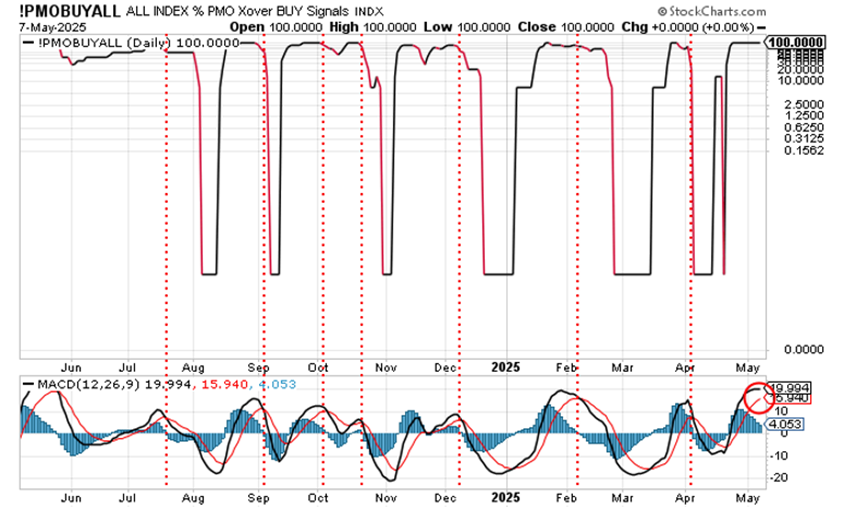
One critical tool informing Clark’s current bearish outlook is the PMOBUYALL indicator. This momentum tool varies between zero and 100.
– At **zero**, most of the decline’s fuel is depleted, suggesting a buying opportunity.
– Conversely, at **100**, the potential for a rally has diminished, indicating a point to sell or go short.
While not a timing tool, the PMOBUYALL provides a broad perspective on market movements. An analysis of recent data shows:
> “The PMOBUYALL has hit 100 seven times in the past year, each time indicating a near-high for the S&P 500.”
Currently, PMOBUYALL has remained at 100, with the MACD indicator starting to decline, hinting that a downtrend might commence soon.
### Implications of the Recent China Trade Deal
Despite the hype surrounding the recent trade agreement with China, Clark’s viewpoint remains unchanged; the deal could just amplify the forthcoming drop.
His recent update highlighted:
> “The news sparked a purchasing frenzy, pushing the S&P to potentially breach key resistance levels. Those with excessive short positions may feel compelled to chase the market.”
He issued a stern warning against buying into what may soon prove to be an overbought situation.
### Current Market Position and Predictions
Today, Clark has recommended a bearish trade on the S&P. He observes:
> “Conditions that previously supported last month’s market bounce are now signaling potential declines.”
He also noted that the S&P is trading significantly above its moving averages, with indicators reflecting a shift from oversold to overbought conditions. Historical parallels suggest that the current setup resembles that of April 2022, where stocks faced notable downturns.
Clark forecasts a bearish market bottoming out around 4,125 later this fall, representing a potential decrease of approximately 30% from current levels.
In conclusion, for those navigating the tumultuous market landscape, Clark encourages patience and strategic planning.
Have a good evening,
Jeff Remsburg