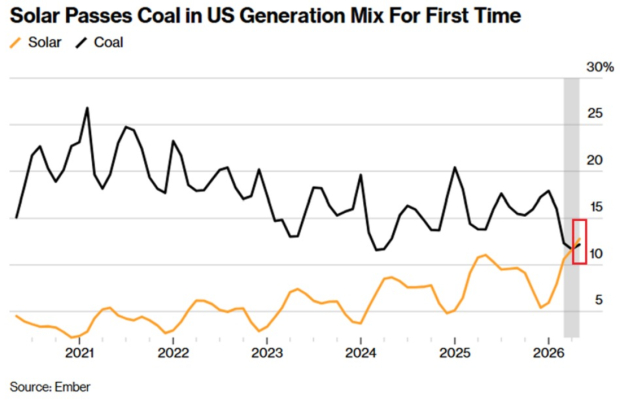
Peabody Energy (BTU), based in St. Louis, Missouri, is facing significant challenges amid changing energy production dynamics. For the first time in history, solar energy accounted for 12.8% of U.S. electricity in May, surpassing coal’s 12.2%. This shift is part of a broader trend in which solar and battery storage represent 91% of U.S. power capacity installed in Q1 2026. Despite surging U.S. electricity prices driven by AI data centers, Peabody’s earnings per share (EPS) have turned negative, and the company has missed analyst expectations in five of the past six quarters.
The Centurion mine in Australia, once considered a flagship operation, produced only 250,000 tons in Q1, significantly underperforming against a target of 700,000 tons due to mechanical and electrical issues. As a result, BTU shares have dropped over 20% year-to-date, contrasting with the S&P 500’s gain of more than 7%.
Overall, Peabody Energy’s strategy to diversify into metallurgical coal, which now accounts for a third of its revenue, is not enough to counteract its current underperformance and negative sentiment in the coal market.
5 Stocks Our Experts Predict Could Double In the Next Year
By submitting your email, you'll also get a free pivot & flow membership. A free daily market overview. You can unsubscribe at any time.