“`html
Gilead Sciences and GSK: Analyzing Competitive Advantages in HIV Treatment
Gilead Sciences, Inc. (GILD) and GSK (GSK) are acknowledged leaders in the field of human immunodeficiency virus (HIV) treatment.
Gilead Sciences commands a significant share of the HIV market, with its HIV drug sales making up 69% of total product sales in the first quarter of 2025. The company also offers a range of therapies for conditions such as liver diseases, hematology/oncology, and inflammation/respiratory diseases.
Similarly, GSK boasts a robust HIV portfolio. In its first quarter, HIV drug sales accounted for 23% of its total revenues. GSK’s extensive therapeutic reach includes treatments for respiratory illnesses, oncology, and a comprehensive array of vaccines. Both companies have consistently returned value to shareholders through solid sales and earnings momentum. This backdrop presents a challenge in selecting one stock over another. To make a well-informed decision, we will examine their fundamentals, growth prospects, challenges, and valuation levels.
Evaluating Gilead Sciences (GILD)
Gilead is a formidable force in the HIV treatment arena. Its leading drug, Biktarvy (bictegravir 50 mg/emtricitabine 200 mg/tenofovir alafenamide 25 mg), has become the most prescribed regimen for both treatment-naïve and switch patients. It holds over 51% of the U.S. treatment market, positioning GILD favorably for upcoming quarters.
Additionally, Descovy (FTC 200 mg/TAF 25 mg), used for pre-exposure prophylaxis (PrEP), shows promising uptake, capturing more than 40% of the U.S. PrEP market.
The company’s innovation pipeline is noteworthy. Recent late-stage studies, PURPOSE 1 and PURPOSE 2, have demonstrated the potential of lenacapavir for HIV prevention. The FDA has accepted new drug applications for lenacapavir with a priority review, targeting a decision date of June 19, 2025.
In parallel, the European Medicines Agency has validated Gilead’s marketing applications for lenacapavir. If approved, lenacapavir could redefine standards for HIV prevention, allowing it to reach a broader audience in need of prevention options.
Gilead’s oncology portfolio, which includes Cell Therapy and the breast cancer medication Trodelvy, further diversifies its business operations. Trodelvy has performed well following its approval, but its Cell Therapy franchise, which includes Yescarta and Tecartus, is under pressure from competitive challenges expected to persist through 2025.
Moreover, Gilead is advancing its liver disease portfolio, which targets hepatitis C, chronic hepatitis B, and chronic hepatitis delta viruses. Recent FDA approval of seladelpar, marketed as Livdelzi, bolsters this segment.
As of March 31, 2025, Gilead reported a total debt-to-total-capital ratio of 56.7%. The company holds $7.9 billion in cash and marketable securities, against $22.1 billion in long-term debt.
Analyzing GSK
GSK’s HIV sales are bolstered by strong demand for its products including Cabenuva, Apretude, and Dovato.
The company is advancing towards next-generation HIV treatments with integrase inhibitors (INSTIs) for both treatment and prevention. Cabenuva, a long-acting injectable regimen, has seen strong uptake in both the United States and Europe.
Dovato, recognized as the first once-daily two-drug regimen for HIV treatment, remains the top seller in GSK’s HIV portfolio. Additionally, Apretude is gaining traction as the first long-acting injectable option for HIV prevention.
GSK is actively developing three new INSTIs and has five planned product launches, which should contribute to growth over the next decade. Its diverse portfolio includes drugs for oncology, respiratory illnesses, immunology, and a wide array of vaccines.
Notably, GSK’s drug Nucala has achieved substantial success, while new oncology products like Jemperli and Ojjaara gain patient acceptance, driving revenue. Recent approvals in the United States for products targeting anemia and RSV are expected to bolster growth as well.
GSK’s pentavalent meningococcal vaccine, Penmenvy, along with Blujepa for treating uncomplicated urinary tract infections, received approval in early 2025.
However, the company faces challenges, including a difficult macro environment in China and potential changes in U.S. vaccination policies, which could affect vaccine sales in the short term.
As per its financials on March 31, 2025, GSK’s net debt stood at $23.2 billion, balanced by $5.8 billion in cash and liquid investments, which exceeds its short-term debt of $2.5 billion. The debt-to-capital ratio was noted at 57.4%, an increase from 56.5% as of December 2024.
Comparing Estimates: GILD vs GSK
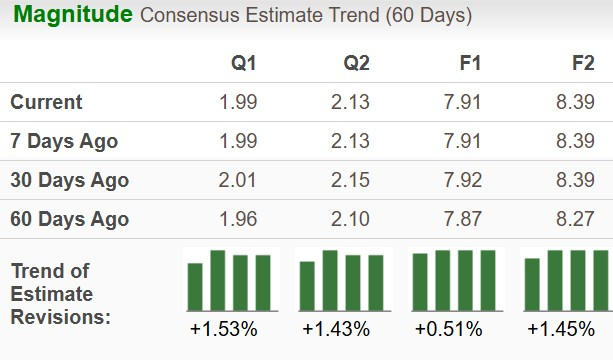
The Zacks Consensus Estimate for GILD’s 2025 sales reflects a slight decrease of 0.84%, while earnings per share (EPS) are projected to grow by 71.21%. Estimates for both 2025 and 2026 have seen upward revisions over the past 60 days.
GILD’s Estimate Trends

Image Source: Zacks Investment Research
In comparison, the Zacks Consensus Estimate for GSK’s 2025 sales indicates a year-over-year increase of 6.2%, with EPS also expected to rise by 6.17%. Similar to GILD, EPS forecasts for 2025 and 2026 have been revised upward in the past 60 days.
GSK’s Estimate Trends

Image Source: Zacks Investment Research
“`
GILD vs. GSK: Year-to-Date Performance and Valuation Insights
Price Performance Overview
In 2023, Gilead Sciences, Inc. (GILD) has outperformed GlaxoSmithKline PLC (GSK) in terms of stock returns. GILD shares have increased by 15.7%, compared to a 14.7% gain for GSK. In contrast, the broader biotech industry has seen a decline of 6.2% during the same timeframe.

Image Source: Zacks Investment Research
Valuation Insights
When it comes to valuation, GILD shares are trading at a forward earnings multiple of 13.11X, which is higher than GSK’s multiple of 8.44X. This suggests that investors are paying a premium for GILD compared to GSK.

Image Source: Zacks Investment Research
Another notable factor for investors is the dividend yield. GSK offers a dividend yield of 4.48%, surpassing GILD’s yield of 3.08%.
Assessing Investment Potential
Large biotech firms like GILD and GSK are perceived as stable options for investors in the sector. Both companies have established themselves in the dynamic and often unpredictable biotechnology market.
GILD’s focus on innovation, particularly in its HIV product line, positions it for future growth. The upcoming potential approval of lenacapavir for HIV prevention, scheduled for June 2025, serves as a significant growth catalyst. However, GILD’s revenue from its HIV segment, which constitutes a considerable share of its total income, faces pressures from the new Medicare Part D model. Additionally, challenges are present in GILD’s oncology business.
Currently, GILD holds a Zacks Rank of #3 (Hold), indicating a cautious outlook for the stock.
Conversely, GSK is also performing well in the HIV market. The company is experiencing sales growth due to successful launches in oncology and long-acting HIV medications. Promising new cancer drugs, such as Ojjaara and Jemperli, bolster GSK’s portfolio. Furthermore, the potential for label expansions of key drugs is expected to support future growth.
With a Zacks Rank of #2 (Buy), GSK appears to be the more attractive option at present, thanks to its diverse portfolio, upcoming product launches, and positive revisions in earnings estimates.