Boosting Income: Core Natural Resources Stakeholders and Covered Calls
Enhancing Returns on CNR with Covered Calls
Shareholders of Core Natural Resources Inc (Symbol: CNR) seeking to increase their income beyond the stock’s 1% annualized dividend yield have an interesting option. By selling a covered call for December at the $120 strike price, they can earn a premium of $6.00. This trade represents an additional 6.9% return on the current stock price, which could boost the total annualized rate to 8%, assuming the stock is not called away. It’s important to note, however, that any profit above $120 would be forfeited if the stock price rises enough for the shares to be called away. Since CNR would need to increase by 24.9% before that happens, shareholders could still enjoy a solid 31.1% return from this trading strategy, along with any dividends accrued before the call.
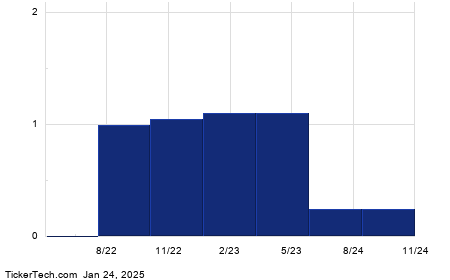
Predicting dividend amounts can be difficult. They often fluctuate based on how profitable a company is at any given time. Evaluating Core Natural Resources Inc’s dividend history (see the chart below) may help investors assess the likelihood of maintaining a 1% annualized yield.

Below is a chart showcasing CNR’s trading history over the last twelve months, with the notable $120 strike highlighted in red:

The aforementioned chart, when evaluated alongside the stock’s historical volatility, can aid in determining if selling the December covered call at the $120 strike provides a favorable risk-to-reward ratio, despite the potential loss of upside past $120. We calculated CNR’s trailing twelve-month volatility to be 40%, considering the last 249 trading days and today’s price of $96.20. For additional ideas, check out the CNR Stock Options page on StockOptionsChannel.com.
In mid-afternoon trading on Friday, put volume among S&P 500 components reached 1.20 million contracts, while call volume stood at 2.57 million. This results in a put-call ratio of 0.47, indicating significantly higher call activity relative to puts. The long-term median put-call ratio is 0.65, suggesting that buyers are favoring calls in today’s options trading.
 Top YieldBoost Calls of Stocks Conducting Buybacks »
Also see:
• KMT market cap history
• Funds Holding BWG
• Institutional Holders of GFS
The views and opinions expressed herein are the views and opinions of the author and do not necessarily reflect those of Nasdaq, Inc.