
Income investors navigating the tumultuous waters of the stock market often gravitate towards companies that not only have a history of consistent dividend payments but also boast attractive dividend yields. In the realm of dividend generosity, one might be inclined to think of mammoths such as Microsoft (NASDAQ: MSFT) and Apple (NASDAQ: AAPL) — both among the illustrious “Magnificent Seven” stocks.
Peeling back the layers of dividend payouts, the limelight often shines on companies with the highest dividend expenses, a domain ruled by titans like Microsoft. Let’s delve into why Microsoft spearheads this elite group and why the tech giant may present a compelling investment opportunity in the current market landscape.

Image source: Getty Images.
Microsoft: Surpassing Dividend Milestones
A glance at the 10 U.S.-based companies with the most substantial dividend expenses reveals a convergence of financial powerhouses, a group that includes industry stalwarts like ExxonMobil and Bank of America, all nestled within the venerable Dow Jones Industrial Average.
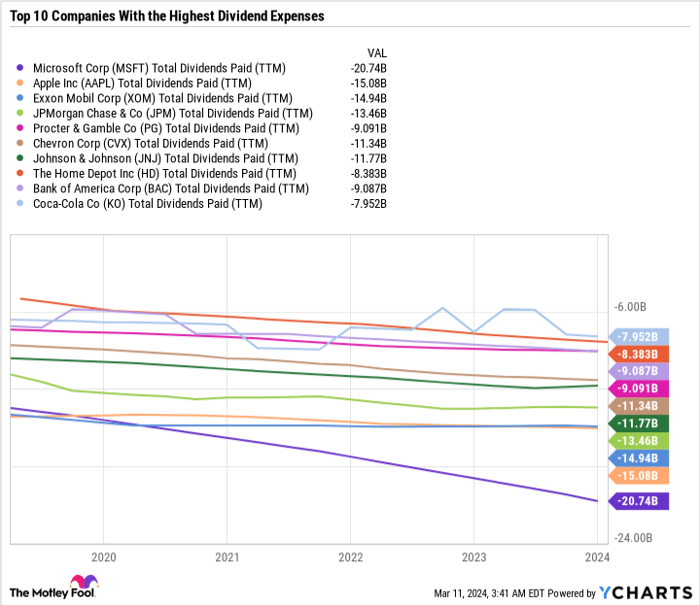
MSFT Total Dividends Paid (TTM) data by YCharts.
Panning across Microsoft’s dividend trajectory, it’s evident that the tech behemoth has embarked on a meteoric rise in dividend payouts. Over the last six years, Microsoft has nearly doubled its dividend and showed no signs of slowing, with a more than 10% increase in dividends for fiscal 2024 alone. Each incremental dividend raise translates into a billion-dollar surge in dividend expenses for Microsoft, a testament to its financial fortitude and commitment to shareholders.
On the flip side, Apple’s dividend policy has been more conservative, with nominal increments of 1 cent per share per year. The tech giant prioritizes returning value to shareholders through stock buybacks rather than conventional dividends.
Decoding Microsoft’s Dividend Strategy
Despite sporting a modest yield of 0.7%, Microsoft shines as the frontrunner among the Magnificent Seven in terms of dividend generosity, even amidst the recent introduction of Meta Platforms’ dividend.
While Microsoft’s dividend hikes have been substantive, outstripping its own growth rate, the stock’s exponential price surge has led to a gradual reduction in its dividend yield. Over the past decade, Microsoft’s management has nearly tripled its dividend. Yet, the stock’s remarkable 900% appreciation within the same period has caused the yield to dwindle from over 2.5% to the current 0.7% mark.
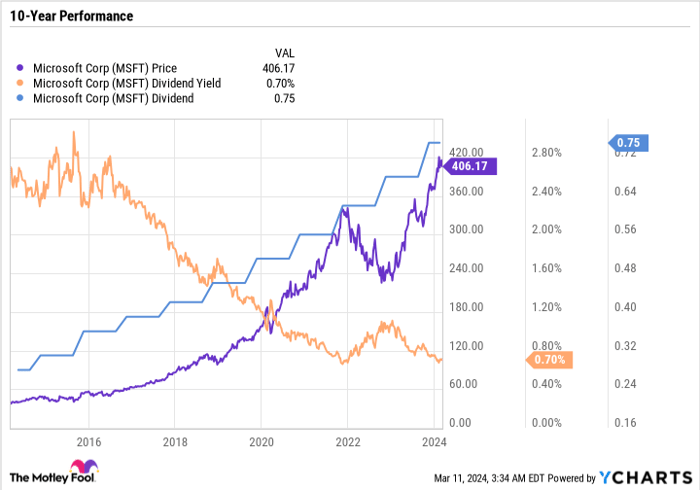
MSFT data by YCharts.
When considering investments aimed at generating passive income over the long haul, a company’s commitment and capacity to bolster its dividend payments prove pivotal. Microsoft’s ability to consistently enhance its dividend, coupled with its prowess in buybacks, operational funding, and research, positions it as a multifaceted investment opportunity, where dividends are merely the cherry atop an extensive investment mosaic.
Formulating an Investment Narrative
Embarking on an investment journey involves analyzing a company’s shareholder rewards mechanism, whether through capital gains, dividends, or stock repurchases. Each entity is inclined towards a specific lever, defining its investment thesis.
In the realm of capital gains, companies like Amazon and Tesla dominate, emphasizing expansion over traditional dividends. Conversely, incumbent dividend players such as Procter & Gamble underscore the significance of dividends and buybacks in their investment narrative, a strategy that has rewarded shareholders while outperforming market benchmarks.
Standing out as a rare breed are companies like Microsoft, which seamlessly navigate growth pursuits while generously rewarding shareholders through a hybrid approach of buybacks and dividends. Microsoft’s recent feats include a 3% reduction in outstanding shares, a 63% surge in dividends, and a stellar 255% surge in stock prices over the last five years, culminating in a trifecta of shareholder delight.
Navigating AI Terrain with Microsoft
Microsoft’s allure transcends mere investment avenues, emerging as a beacon of stability and potential in an ever-evolving market landscape. Boasting robust cash flows and a resilient balance sheet, Microsoft basks in the freedom to innovate, undertake risks, and disrupt industries, all while presenting a clear roadmap for profiting from artificial intelligence (AI).
One of Microsoft’s standout AI innovations is Copilot, an integrated AI assistant across Microsoft 365 and GitHub, heralded for boosting productivity and efficiency. While Copilot plays a pivotal role, Microsoft’s AI prowess extends beyond, encompassing Azure AI in its Intelligent Cloud segment, diversifying revenue streams and fortifying its market position.
Embracing an AI-centered strategy, Microsoft anticipates a cascading effect on profitability and growth, paving the way for accelerated share price appreciation, enhanced buyback programs, or expedited dividend hikes. Investors stand to reap rewards irrespective of the investment lever Microsoft opts to engage.
Microsoft’s Premium Valuation for Discerning Investors
Microsoft’s sole caveat pertains to its prevailing valuation, soaring at a 36.8 price-to-earnings (P/E) ratio — well above its historical average and the market benchmark. Despite the lofty valuation, investors imbue high expectations into Microsoft’s growth trajectory, hinting at a backdrop of optimism surrounding the tech juggernaut.
Yet, the narrative isn’t devoid of cautionary tones; Microsoft’s earnings will steer the course of its valuation, fostering a climate where diligent investments are critical. While the stock’s premium tag may pose challenges, Microsoft’s enduring commitment to innovation and shareholder rewards solidify its position as a sage investment in AI realms, blending robust growth potential with passive income streams.
Where to invest $1,000 right now
When our analyst team speaks, it’s wise to listen. With decades of astute analysis, the Motley Fool Stock Advisor has transcended market averages, presenting the 10 best stocks, with Microsoft reigning supreme among the highlights — yet 9 other gems await your exploration.
Discover the 10 stocks
*Stock Advisor returns as of March 11, 2024
JPMorgan Chase and Bank of America are advertising partners of The Ascent, a Motley Fool company. John Mackey, former CEO of Whole Foods Market, an Amazon subsidiary, serves on The Motley Fool’s board of directors. Daniel Foelber has no position in any of the mentioned stocks. The Motley Fool holds positions in and recommends Amazon, Apple, Bank of America, Chevron, Home Depot, JPMorgan Chase, Microsoft, and Tesla. Additionally, it recommends Johnson & Johnson and the following options: long January 2026 $395 calls on Microsoft and short January 2026 $405 calls on Microsoft. The Motley Fool maintains a disclosure policy.
The opinions articulated herein reflect the author’s perspective and don’t necessarily mirror those of Nasdaq, Inc.
5 Stocks Our Experts Predict Could Double In the Next Year
By submitting your email, you'll also get a free pivot & flow membership. A free daily market overview. You can unsubscribe at any time.