Retirement marks a celebratory phase in life, yet it also introduces a myriad of crucial decisions for new retirees. Among these critical choices is determining the timing of claiming Social Security benefits, which constitute a substantial income source for numerous retirees across the nation.
This decision is far from simple because individual circumstances vary, necessitating diverse approaches and factors to consider. However, a single pivotal number can significantly aid in your decision-making process: your break-even age.

Image source: Getty Images.
The Starting Point: Your Full Retirement Age
Commencing your decision-making process with your full retirement age (FRA) is crucial. This age denotes when you qualify to receive your base Social Security benefit, also known as the primary insurance amount (PIA). The Social Security Administration utilizes your PIA to determine adjustments to your monthly benefits based on your claiming age relative to your FRA.
While claiming benefits as early as 62 is an option, your monthly benefit diminishes depending on the proximity of your claim to your FRA. Within 36 months of your FRA, benefits reduce by 5/9 of 1%, with a further 5/12 of 1% reduction for each additional month. For instance, an individual with a full retirement age of 67 would experience a 20% reduction in their monthly benefit at 64 and a 30% reduction at 62.
On the flip side, delaying benefits beyond your FRA leads to an increase of two-thirds of 1% each month, translating to an 8% annual boost until age 70.
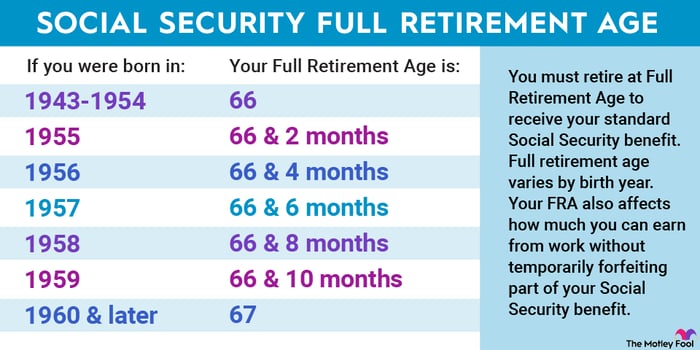
Image source: The Motley Fool.
Looking at the Bigger Picture
While the idea of receiving Social Security benefits at the earliest opportunity or maximizing the monthly benefit might seem appealing, these factors alone should not dictate your claiming decision. It’s advisable to adopt a holistic view, focusing on your total Social Security benefits over your retirement years, termed lifetime or cumulative benefits. This is where your break-even age assumes significance in providing a clearer perspective.
The break-even age signifies the point where the total benefits received from an earlier claim equal those obtained from a later claim. For instance, someone with an FRA of 67 and a PIA of $1,900 (just below the average monthly benefit for retired workers in Jan. 2024) would see a 24% rise in their monthly benefits by delaying until age 70, reaching $2,356.
Calculations demonstrate the accumulative benefits a person would receive by different ages:
| Monthly Benefit | Total by Age 80 | Total by Age 82 1/2 | Total by Age 85 |
|---|---|---|---|
| $1,900 | $296,400 | $353,400 | $410,400 |
| $2,356 | $282,720 | $353,400 | $424,080 |
Calculations by author.
In this scenario, the break-even age is 82 1/2. Prior to that age, claiming benefits at 67 results in higher total benefits compared to delaying until 70, despite the additional $456 per month. After reaching age 82 1/2, delaying benefits becomes more financially advantageous, resulting in higher lifetime benefits.
Integrating the Break-Even Age into Your Decision-Making
While the break-even age should play a role in your Social Security claiming strategy, it must not serve as the sole determinant. It is essential to evaluate your financial status, personal and family health history, and retirement aspirations.
If your expenses cannot be covered without Social Security, an early claim may be necessary, irrespective of your break-even age. Conversely, if you have retirement savings and Social Security serves as supplemental income, delaying for a higher monthly payout might be advantageous. Additionally, early claiming could be optimal for maximizing lifetime benefits in the presence of significant health concerns.
Individual circumstances vary significantly, influencing the factors considered in your decision-making process and their respective weight. The crucial aspect is to take all relevant details, including your break-even age, into consideration.
The $22,924 Social Security bonus most retirees completely overlook
If you find yourself trailing in your retirement savings compared to most Americans, uncovering some lesser-known “Social Security secrets” could potentially boost your retirement income. Learning to maximize your Social Security benefits may offer a path to retiring with confidence and the sought-after peace of mind. Discover more about these strategies by clicking here.
View the “Social Security secrets”
The Motley Fool has a disclosure policy.
The perspectives shared in this piece reflect the author’s views and opinions and may not align with those of Nasdaq, Inc.