Market Volatility: Reasons Behind Recent Stock Declines
After stocks fell sharply on Friday, with the Nasdaq dropping below its year-to-date high, investors may be questioning the stability of the US equity bull market. Here are several reasons why the recent sell-off may be overstated, and why the bull market could still be on solid ground:
Understanding Seasonal Trends
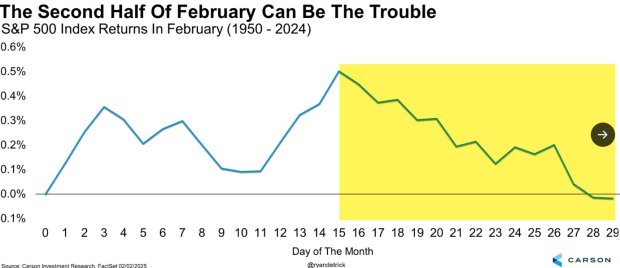
On Wall Street, investors often look at seasonal patterns to gauge stock performance at different times of the year. Just as farmers plant crops based on weather, investors analyze historical data for better decision-making. For instance, late February in a post-election year, like 2025, typically sees a downturn as market enthusiasm wanes.
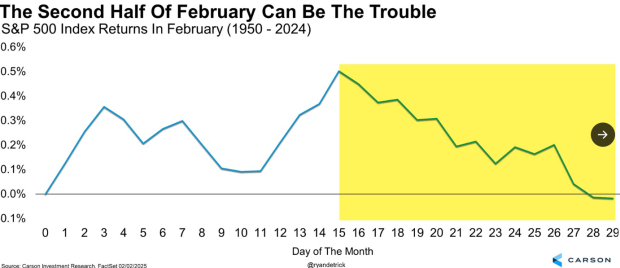
Image Source: Ryan Detrick, Carson Investment Research
Normal Drawdowns in Bull Markets
The S&P 500 Index typically experiences several declines throughout the year, with an average yearly drawdown of about 14.2%. Understanding these patterns helps investors manage their risks and avoid getting too invested when market conditions seem stretched.
Impact of Monthly Options Expiration
The drop on Friday may have been intensified by monthly options expiration (OPEX). On these days, price movements can be unpredictable as traders adjust their positions. Historical data shows that the Friday of February OPEX has seen lower prices in 14 out of the past 24 instances. Following OPEX, stocks might reach a more stable state.
Overreaction to Government Job Cuts
Concerns stemming from Elon Musk’s “Department of Government Efficiency” (DOGE) initiative are also influencing market sentiment. With Musk’s team offering generous severance packages and implementing a strict return-to-office policy, some fear a larger impact on the job market. President Trump’s recent comments urging aggressive government cuts have added to anxieties. Yet, looking back at the budget cuts during President Obama’s administration from 2011 to 2014, 146,000 federal jobs were eliminated, yet the economy still added over 8 million jobs.
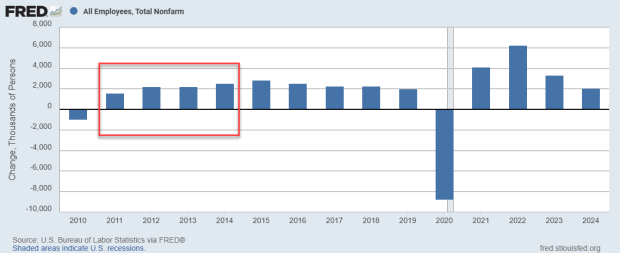
Image Source: US Bureau of Labor Statistics
Thus, fears regarding DOGE appear somewhat exaggerated.
Investor Sentiment: Caution Ahead
Despite major indices being within 5% of their all-time highs, sentiment indicators like the CNN Fear and Greed Index are showing signs of unease, flashing a “Fear” reading recently.
Strong AI Investments Are Here to Stay
With AI and technology stocks driving market growth, worries about a slowdown in AI spending are surfacing. Recently, Apple (AAPL) announced plans to invest over $500 billion to boost AI initiatives and incorporate Alphabet’s (GOOGL) Gemini AI into its products.
Moreover, while reports suggested that Microsoft (MSFT) would cut back on AI budgets, a Jeffries report strongly disputed those claims. Simultaneously, spending on AI in China is on the rise, with Alibaba (BABA) planning a $53 billion investment in cloud and AI infrastructure over the next three years. Investors are poised to learn more about AI spending when Nvidia (NVDA) reveals its earnings this Wednesday.
Discover the Top Opportunities for 2025 Now
Explore our latest selection of top stocks for 2025. This portfolio, curated by Zacks Director of Research Sheraz Mian, has achieved remarkable success since 2012, returning +2,112.6% compared to the S&P 500’s +475.6%. Don’t miss your chance to be among the first to learn about these promising stocks.
Get the Latest Recommendations: Download our report on 7 Best Stocks for the Next 30 Days for free!
Apple Inc. (AAPL) : Free Stock Analysis Report
Microsoft Corporation (MSFT) : Free Stock Analysis Report
NVIDIA Corporation (NVDA) : Free Stock Analysis Report
Alphabet Inc. (GOOGL) : Free Stock Analysis Report
Alibaba Group Holding Limited (BABA) : Free Stock Analysis Report
This article originally published on Zacks Investment Research (zacks.com).
Zacks Investment Research
The views and opinions expressed herein are the views and opinions of the author and do not necessarily reflect those of Nasdaq, Inc.